 |
| Servian wall in Aventine area, Rome. Built 4th C. BC to protect against Gaul/Celt invasions. Each long block is about 18" long. Made of the local volcanic stone before fired bricks and cement were invented. |
Archeology of Aventine Hill: seminar and walking tour
Worlds opening yet again in many and unexpected ways.
The heart of the Roman Empire. I have traveled around the edges from the Jordanian and Syrian cities of the decapolis to the remote trading posts in the Tunisian desert or Londinium. Now, I have managed to reach the center only to find that the Republic and Empire have been overlaid by so many other eras and uses that confusion abounds when trying to sort out my thoughts. Sigh.
But that is the joy of retirement and the leisure to wander. My luck is to have access to some of the best in current archeology in Rome. A couple of weeks ago, I was privileged to participate in a seminar and walking tour specializing in an area of Rome but which was less-renowned but always within the walls. That and a few other opportunities have helped me grasp some of the complexity of this city which has been central to western civilization for so many centuries.
The American Academy in Rome (AAR) sponsored a seminar bringing together archeological knowledge with a broader interest in the relationship between the built environment and historical social process. This event had a star-studded cast as far as I am concerned: superintendent of the National Museum of Rome, superintendent of archeology of Lazio and Etruria, professors of medieval archeology, roman archeology and much, much more. Be still my heart. All I had to do was show up.
The seminar, on March 24, included presentations on specific areas of Aventine Hill, one of the seven hills of Rome, just SW of Palatine Hill and the Roman Forum, the true heart of historical Rome. Aventine is a Rome neighborhood now of upscale housing and religious communities. In the past it was suburban or farmland, but within the defined area of the city at least from the 4th C. BC.
In addition to superb consolidation of previous information, recent research was explored and fitted within the framework of the area. Lisa Mignone, previously a fellow of AAR and one of the early speakers, set the stage for the discussion which looked at Aventine in a structural mode as a rural/suburban area which functioned to provide stability to the city of Rome and the Roman Republic. Several participants spoke to me as if this is a somewhat new direction in thinking for Roman Archeology, which has been in a collection and salvage mode for a very long time, for obvious reasons. It appears that one of the gifts that AAR brings is pulling together strands of thought from varying disciplines and in this case enlarging the frame of the discussion.
Roman archeology is coping with the continued difficulty of making sense of what is already collected, salvaging what is being disrupted, and relating what is known to the on-going life of the city. In addition to the presenters and partners already mentioned, the Stalker Collective, a group of Roman architects and urbanists interested in the intersections of urban life, participated in the seminar and led a walking tour the following day to key sites discussed. Lorenzo Romito, one of the key Stalker participants, kindly watched out for me and translated for me quite often. Read more about the Stalker Collective here and here. The mix is totally counter-intuitive and just fascinating. The AAR is to be congratulated for participating in bringing these sets of people together. I hope I will be able to follow the thought which comes out of the junction but it will likely be fairly local to Rome and mostly in Italian. My loss.
I have had the privilege to participate in two other excellent archeological seminars since arriving. One, also at the American Academy, pulled together excavations which reached as far back as Iron-Age farming and irrigation in an area where a new Metro Line C station is being built near San Giovanni Laterano. Later, another at the British School of Rome discussed their ongoing exploration of the Adriatic during the Dark Ages and Medieval Era.
Since I haven't remained in academia and was only peripherally connected to archeology anyway, I am having such a good time opening doors to new areas. Here, a term used in the discussions is "wormhole." I am not sure if it has widespread academic usage but it seems so. However, it is a handy term to state that we are looking down through the earth in a hole and have only bits of knowledge from that spot. We pull together the information from multiple wormholes to try to make some sense of the eras we are learning about.
Our Aventine Hill walking adventure explored several wormholes with specific information and insights on key areas and eras. An overall theme is of the Aventine area as a rural area within the walls of one of the densest cities known on earth during the era of the Roman Empire.
Pilgrims during the Dark Ages--Arch of San Lazzaro
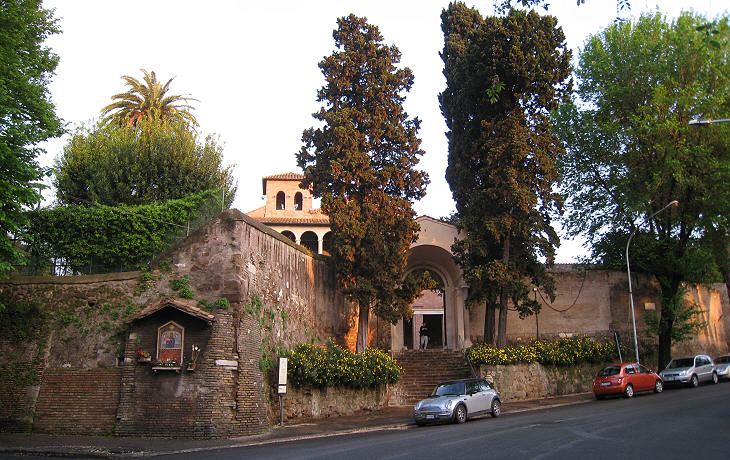
We started in the Dark Ages/Medieval Period. This is the period between about 500-1200 AD. Much can be written or discussed about the names of these times but it is way too much for this blog. Just go with these terms for now. The Arch of San Lazzaro, our meeting point, was also the meeting point for Christian pilgrims who were leaving the safety of the city walls for the pilgrimage to St. Paul Outside the Walls, where St. Paul is buried. The arch is now a remnant outside an upscale restaurant beside a busy street. Our bus goes there so I have become interested in this fragment which looks so minor now but was a major transition from safety to danger for pilgrims in the past.
The arch which remains was attached to the chapel and hospital of San Lazzaro, the hospital for lepers. Pilgrims typically donated to the hospital prior to their journey to St. Paul several miles south. The hospital was demolished in the 19 C to build the big road now there. But, the arch we see is actually a left-over from an earlier structure, the giant warehouse used when Rome was an empire importing tons of grain through the ports at Testaccio. It was constructed after fired brick and cement replaced tufa stone as the predominant building material--about 2nd C. BC. Other remnants of the warehouses are found around Testaccio. I just love that so many things we see are reuses of many prior functions: warehouse, hospital, upscale restaurant and my bus stop.
San Saba Church
Other medieval stops along our tour included San Saba Church and the upper levels of Santa Prisca Church and Santa Sabina Church. Aventine is good for remains of this period since it was not a prized area during the Renaissance and Baroque periods so the earlier forms and art remain. Most of Rome was so remodeled during the Renaissance and Baroque that you can barely discern the medieval city. I love the visuals of the medieval period so I delight in the Aventine area which still has many remnants.
This church was built by refugees from the Bethlehem area, able to found a community since the area was lightly used when they arrived to seek refuge. Although it was founded in 645, it was remodeled in the 12th C so the frescoes are from that period. I am unclear about the mosaics which may have been from the earlier period. The relic of San Saba is only a small part of the burial; the remains of Mar (Saint) Saba were taken back to the monastery near Bethlehem where the original refugees came from and which remains an active monastic community.
Severan Wall-- built during 4th C. BC.
Several stops included the Severan wall which was built around Rome in the 4th C. BC when Rome and other parts of Italy were invaded by the Celts/Gauls coming in from the area that is now France. The earliest building material for the walls is the yellowish volcanic stone called "tuff"--see the top photo in the blog. The walls were repaired and maintained using smaller blocks of limestone and mortar as in these photos. In the Middle Ages, local farmers cut the stone and built houses within the wall.
Mausoleo di Cilone
The Mausoleo di Cilone (Mausoleum of the Cilone family) was another wormhole in a section of Aventine which has remained like a country meadow for much or all of its history. The Mausoleo is under continued excavation, no public access. Lights and access for us though. These photos show our arrival and the interior of the site. It was the grave of a family for centuries. During the Middle Ages it was used for storage for agricultural products of the surrounding area and has remained undisturbed by modern building, unlike most of Aventine.


Santa Prisca Parish Church
The Santa Prisca Church wormhole, our next area, by contrast was relatively heavily used at least from the 1 C. AD. Since it was well within the Severan wall and looks out toward Palatine Hill, the probability is that the area was used beginning in the early Iron Age for farming and housing but the evidence has not emerged. Exploration is ongoing in several areas. The archeological sites are so dense and of such quality that it is clear that the area will offer much more over time.
Sta. Prisca, the current Catholic parish church, was a Christian monastic church from at least the 5 C. AD. It was previously a Mithraeum (place of worship for the cult of Mithras) during the Roman Imperial Era (Julius Caesar and later), and before that it appears to have been a temple for Diana (or Artemis to the Greeks), possibly during the republic and imperial eras. We had an opportunity to don hard hats and go in small groups to several places in the general location. I visited only 2 which I show below. First I show the Mithraeum below the Medieval Church both of which are directly below the current parish church.
An Imperial-Era Dwelling Near Santa Prisca
The following set of photos show a Roman house from the Republican Era. Unfortunately, no one was there to tell me in English what we were looking at but the frescos on wall and ceiling are remarkably well-preserved. Access is limited but we were able to visit as conference participants.


General Views of Aventine Neighborhood
A few parting shots of our group which shows the lovely Aventine Hill neighborhood.
Text and photos by Julianne.
Roman archeology is coping with the continued difficulty of making sense of what is already collected, salvaging what is being disrupted, and relating what is known to the on-going life of the city. In addition to the presenters and partners already mentioned, the Stalker Collective, a group of Roman architects and urbanists interested in the intersections of urban life, participated in the seminar and led a walking tour the following day to key sites discussed. Lorenzo Romito, one of the key Stalker participants, kindly watched out for me and translated for me quite often. Read more about the Stalker Collective here and here. The mix is totally counter-intuitive and just fascinating. The AAR is to be congratulated for participating in bringing these sets of people together. I hope I will be able to follow the thought which comes out of the junction but it will likely be fairly local to Rome and mostly in Italian. My loss.
I have had the privilege to participate in two other excellent archeological seminars since arriving. One, also at the American Academy, pulled together excavations which reached as far back as Iron-Age farming and irrigation in an area where a new Metro Line C station is being built near San Giovanni Laterano. Later, another at the British School of Rome discussed their ongoing exploration of the Adriatic during the Dark Ages and Medieval Era.
Since I haven't remained in academia and was only peripherally connected to archeology anyway, I am having such a good time opening doors to new areas. Here, a term used in the discussions is "wormhole." I am not sure if it has widespread academic usage but it seems so. However, it is a handy term to state that we are looking down through the earth in a hole and have only bits of knowledge from that spot. We pull together the information from multiple wormholes to try to make some sense of the eras we are learning about.
Our Aventine Hill walking adventure explored several wormholes with specific information and insights on key areas and eras. An overall theme is of the Aventine area as a rural area within the walls of one of the densest cities known on earth during the era of the Roman Empire.
Pilgrims during the Dark Ages--Arch of San Lazzaro
We started in the Dark Ages/Medieval Period. This is the period between about 500-1200 AD. Much can be written or discussed about the names of these times but it is way too much for this blog. Just go with these terms for now. The Arch of San Lazzaro, our meeting point, was also the meeting point for Christian pilgrims who were leaving the safety of the city walls for the pilgrimage to St. Paul Outside the Walls, where St. Paul is buried. The arch is now a remnant outside an upscale restaurant beside a busy street. Our bus goes there so I have become interested in this fragment which looks so minor now but was a major transition from safety to danger for pilgrims in the past.
The arch which remains was attached to the chapel and hospital of San Lazzaro, the hospital for lepers. Pilgrims typically donated to the hospital prior to their journey to St. Paul several miles south. The hospital was demolished in the 19 C to build the big road now there. But, the arch we see is actually a left-over from an earlier structure, the giant warehouse used when Rome was an empire importing tons of grain through the ports at Testaccio. It was constructed after fired brick and cement replaced tufa stone as the predominant building material--about 2nd C. BC. Other remnants of the warehouses are found around Testaccio. I just love that so many things we see are reuses of many prior functions: warehouse, hospital, upscale restaurant and my bus stop.
 |
| Arch of San Lazzaro |
San Saba Church
Other medieval stops along our tour included San Saba Church and the upper levels of Santa Prisca Church and Santa Sabina Church. Aventine is good for remains of this period since it was not a prized area during the Renaissance and Baroque periods so the earlier forms and art remain. Most of Rome was so remodeled during the Renaissance and Baroque that you can barely discern the medieval city. I love the visuals of the medieval period so I delight in the Aventine area which still has many remnants.
This church was built by refugees from the Bethlehem area, able to found a community since the area was lightly used when they arrived to seek refuge. Although it was founded in 645, it was remodeled in the 12th C so the frescoes are from that period. I am unclear about the mosaics which may have been from the earlier period. The relic of San Saba is only a small part of the burial; the remains of Mar (Saint) Saba were taken back to the monastery near Bethlehem where the original refugees came from and which remains an active monastic community.
 |
| San Saba Church with mosaics and frescos. Founded in 645 by Palestinian Christian refugees. |
Severan Wall-- built during 4th C. BC.
Several stops included the Severan wall which was built around Rome in the 4th C. BC when Rome and other parts of Italy were invaded by the Celts/Gauls coming in from the area that is now France. The earliest building material for the walls is the yellowish volcanic stone called "tuff"--see the top photo in the blog. The walls were repaired and maintained using smaller blocks of limestone and mortar as in these photos. In the Middle Ages, local farmers cut the stone and built houses within the wall.
 |
| Severan wall.as repaired in 1 C. BC |
 |
| Severan wall showing where a Medieval house had been built into the wall. |
 |
| Severan wall detail: channel is house foundation. |
Mausoleo di Cilone
The Mausoleo di Cilone (Mausoleum of the Cilone family) was another wormhole in a section of Aventine which has remained like a country meadow for much or all of its history. The Mausoleo is under continued excavation, no public access. Lights and access for us though. These photos show our arrival and the interior of the site. It was the grave of a family for centuries. During the Middle Ages it was used for storage for agricultural products of the surrounding area and has remained undisturbed by modern building, unlike most of Aventine.
Santa Prisca Parish Church
The Santa Prisca Church wormhole, our next area, by contrast was relatively heavily used at least from the 1 C. AD. Since it was well within the Severan wall and looks out toward Palatine Hill, the probability is that the area was used beginning in the early Iron Age for farming and housing but the evidence has not emerged. Exploration is ongoing in several areas. The archeological sites are so dense and of such quality that it is clear that the area will offer much more over time.
Sta. Prisca, the current Catholic parish church, was a Christian monastic church from at least the 5 C. AD. It was previously a Mithraeum (place of worship for the cult of Mithras) during the Roman Imperial Era (Julius Caesar and later), and before that it appears to have been a temple for Diana (or Artemis to the Greeks), possibly during the republic and imperial eras. We had an opportunity to don hard hats and go in small groups to several places in the general location. I visited only 2 which I show below. First I show the Mithraeum below the Medieval Church both of which are directly below the current parish church.
 |
| Entrance to excavations at Santa Prisca Church |
 |
| Altar of Mithraeum with partial figure of Mithras. Usually Mithras was shown sacrificing a bull. |
 |
| Probably Egytpian ceramic bowl from Imperial Era. Embedded in stone, entrance to both Mithraeum and Medieval church. |
 |
| Earliest foundations prior to use as Mithraeum |
 |
| Detail of foundation showing stone used after about 100 BC. |
 |
| Christian frescos just above Mithraeum level |
 |
| Christian frescos; area remains a consecrated chapel. |
The following set of photos show a Roman house from the Republican Era. Unfortunately, no one was there to tell me in English what we were looking at but the frescos on wall and ceiling are remarkably well-preserved. Access is limited but we were able to visit as conference participants.
General Views of Aventine Neighborhood
A few parting shots of our group which shows the lovely Aventine Hill neighborhood.
 |
| Have I mentioned that it was really raining! |
 |
| A Renaissance gate. Although the area was not preferred at that time, some families lived in the area. |
 |
| The Aurelian wall. Built under Marcus Aurelius in 276 AD it also winds through the Aventine. |


