Friday, December 5, 2014

Looking at Roman-Era Sculpture: The Boxer

Rome is chockablock with classical artifacts, in the museums, in open-air sites, lying around in vacant lots and poking out of building facades. 

I have been hoping to understand classical civilization partly on the basis of these physical bits and pieces. But, they’re only bits and pieces, torn from context. The true past is gone; I can’t think how it felt to be there then. I only know what we see now, reconstructed (or not), cleaned up and simplified.

They're still worth looking at. I can appreciate them aesthetically, both in their ruined condition, and as repaired and cleaned up. Also, I do think it’s possible to understand something about the worldview that produced them, as long as I don’t think I’m understanding the whole magilla.

I’m going to do a few blog posts on what we see here in Rome of the antique past. It’s a matter of strict focus – there’s so much, too much. I’ll start with a very well-preserved life-size work in cast bronze. 

See what you think.

Exhibit A is the Boxer of Quirinal, now in the Rome National Museum. He came out of the ground at the original site of Constantine’s Baths, built around 300 CE. But he is much older, dating to the 1st century BC, and true Greek, not a copy. He was in the baths along with a lot of other sculptures; how he got there from Greece is unknown. I can imagine him as one of a group, the others lost or scattered, because he seems to be looking at someone. That’s a supposition.


This boxer, as cast, has had a hard life. He’s scarred and wounded, and has a broken nose. He’s bleeding copper beads of blood. He looks fearful, exhausted, on his last nerve. His bronze toes are a little worn – in ancient times it seems people ran their hand over his toes as they passed. Was it for luck? Pity?


Anyway, it looks like he was recognized as a masterpiece from the first and carefully handled, valued, and preserved for hundreds of years. In the 6th century CE, after the Ostrogoths cut the aqueduct supplying the Baths (and the city) with water, he was apparently carefully buried. He was rediscovered in 1885 when the Baths of Constantine were excavated. Some cleaning was required, and here he sits on his new seat, eye level with ourselves, easy to get close to.

Excavation of Baths of Constantine, photo from 1885

Well, I'm not sure about the "semi-barbaric" part
A very 19th-century comment!

What a miracle, to be in such good shape after 2100 years! What a stroke of luck for us, to have him come to light. I can feel closer to the Romans because of the toe rubbing; I would rub those toes, too. Lovely article in Wikipedia. The Museum’s wall labels are also very explanatory. Rick Steves has good pointers, too.

Now one thing about this boxer, he’s not a winner. Probably he lost his last bout. Despite his physique being tough and well-developed, he’s vulnerable. His mind is perhaps confused. He doesn’t know which way to turn. What’s next for him?

Well, as far as that goes, nobody always wins. We recognize something of our situation in his situation, our sympathy extends to him. 

And those toe-rubbing Romans – they likely felt the same. Thus in looking at this boxer, beautifully placed and lit in the Rome National Museum, we can feel some identification with the Romans of antiquity. In this bronze, we see something of what they saw. 

So that's my feeling about this wonderful bronze - I admire the aesthetic quality, love the story, and feel I've learned something about the Romans who admired and saved him. That was easy. Next, something harder.

by Nancy

Wednesday, December 3, 2014

The Oldest Bank in the World


Banca Monte dei Paschi di Siena
dal 1472

Turns out that the cash machine that we use, downstairs from our apartment, is at this bank's branch in Rome.  It is a fine cash machine and gives us Euros whenever we ask.  For us, this is sufficient in a bank so we have been happy with our financial partner here.

Finally we looked at its name and sign--Banca dal 1472.

Double-take: 1472?  Bank since 1472? Yes.


Our bank in Rome.  Sadly, not our motorcycle.

Our Italian bank has been around awhile.  We love that.  Wells Fargo has only been going since stagecoach days in the American West and they don't even have the stagecoaches on their logo any more.  What kind of sense of history is that?

I imagine our bank having a stake in the original journeys of Christoforo Columbus, although he was Genoese, not Sienese.  One of the banking innovations of the era was the concept of spreading risk. Along with the adoption of Arabic numerals, double entry-bookkeeping, and some other significant financial innovations, this risk-spread thing ushered in a new financial era, underpinning the Renaissance and beginning the modern era in Europe. It's easily possible that they had a stake in Columbus' voyage.

All the early banks were financing shipping, from Italy around to Bruges, London and points west. (No doubt also to Wormerveer, the world center of the whale oil industry in the 1500's.) Although we hear about Spain's Queen Isabella selling her jewels to finance Columbus, as far as I can follow this thread she sold them to banks in Northern Italy.  The banks sensibly were requiring some sort of guarantee in case Columbus fell off the edge of the world, causing severe capital loss.

Banca Monte dei Paschi is the oldest bank in the world now.  They have a fabulous collection of art and architecture from the 14 C. onwards. Their headquarters building shown in this picture dates to the early 1400's, but parts date to the Middle Ages.  This fortified castle became the bank headquarters when the bank was founded in 1472.  Obviously, a period in which banks faced more than financial danger.

Immagine palazzo
Bank headquarters in Sienna

Their website gives much of their history which fascinates me--I am really interested in the financial innovations of the period as a foundation for our current world financial system.  I have been exploring the finances of the Medici in Medici Money by Tim Parks.  Now, we are actually banking (well, getting cash) with one of the institutions of the era.  Florence, and the Medicis, conquered Sienna later, forcing our bank to restructure.  Learning the general financial structures underpinning the Renaissance is interesting but it is really fun following those financial and political twists and turns in the fate of our bank.

Our bank has not done that well during the recent world financial downturn.  Some scandals.  Some mismanagement. Some bad luck.  Failed recent ECB stress test.  Credit ratings agencies do not give good reports.  The banks is putting out news releases that they are improving.  Share price tanked but now is going up a bit.  Many of their competitors from the 1400's have gone out of business, including the Medici.  So we hope Banca Monte di Paschi will be able to carry on now too.


Here is our cash machine--"bancomat" in Italian.  Graffiti is ubiquitous here in Rome and even the oldest bank in the world quietly lives with graffiti and stickering.

None of the bad news affects us--we put in our card, get Euros. Not a complex financial transaction.  But we have bonded with our bank and wish it well.


Sunday, November 23, 2014

Porta Portense Sunday Market

Sunday stroll through the Walmart of Rome

We live upstairs from the southern end of this famous market.  Our end is not the famous flea market; most guidebooks suppose you will shop starting north at the actual Porta Portense, part of Rome's original city wall.  But what our end misses in flea-i-ness, it more than makes up for in selling things that ordinary Romans need to buy.  Us, too.  We need some things to get on with our cozy winter life.


Today was our day to get our stuff and stroll through the whole market.  Cool enough for sweaters.  Not massively crowded.  Vendors doing their vendor act--some are quite lively and others sit around.  No hard sell here--it is pretty pleasant.

We have a list: electric adapter which goes from wide European-style 2 prong to piccolino Italian style 3-in-a row prong.  I have not seen this kind of plug anywhere but Italy so it is not surprising that they have lots of these adaptors around.  But in our house, never enough.

OK: electric adaptor, coffee mugs, shower caddy, clothes pins, toilet brush, knife sharpener, bleach.  That is for the house.  I personally am on the lookout for fuzzy slippers and a winter hat.

It is more fun to search with items in mind.

We have already picked up a frying pan and sauce pan.  Our friend Jean bought a large coffee pot which we use constantly.  This apartment is actually very well equipped but we do not do everything the Italian way--we need big coffee mugs and pans with lids.

The market starts on our end with a hamburger/sausage guy and a few plant stalls.  We have several blocks of clothes stalls--new clothes with every kind of stall from lingerie to shoes to coats, dresses and men's suits.  Fuzzy slippers are mainly for bambini and not my size.  Bummer.  There are winter hats in one stall but I do not need one just yet.  Several stalls of cashmere shawls with no hats.  What's up with that?  African carvings slip in surrounded by coat stalls.

Finally, housewares and electrical stalls.  To-ing and fro-ing to get the electric adaptor and then change for a 10. We manage to use our few words of Italian and have fun with the several guys who have to help in our transaction. This multi-party effort is repeated at the houseware stall where we find a knife-sharpener (affilacoltelli, we now learned) and reject plastic cereal bowls (below the bottom line).

Our shopping is reinforcing our experience that Italians are really nice.  Even in business transactions, our main interactions so far, merchants are personal and willing to try to communicate with us and actually help us.  It is charming.  We have had one Italian lesson so far and have a few things we can say--but cannot remember our words when faced with an actual Italian, so we appreciate their patience.  People in our local stores remember us now and let us try our Italian.  The guys at the butcher shop were gallant in their praise when I learned "mezzo-kilo" of hamburger. (We enjoy our small accomplishments.)

Anyway, the market vendors are just as nice.  And we got our stuff, for the most part.

Coffee mugs are elusive.  We passed out of the new clothes and housewares, through the curtains, slipcovers and chandeliers and reached the actual used-stuff part of the flea market before finding any coffee mugs as we know them in the US.  Italians seem to use tiny coffee cups on tiny saucers or little tea cups with saucers.  No mugs to be had in the new-stuff part of the market.


Since is is a lovely day and we were in wandering mode, we wandered.  The range of old, used stuff that is on offer is mind-boggling, especially to me who hates to shop.  Cameras, scopes.  Old radios and telephones.  Books galore.  Used housewares--including a few mugs.  Finally found one.  Really--one.  For 1 Euro, Ok.

Blocks more of market before we could find our way out.  Yay, we made it to Via di Trastevere and the tram.  At our stop-- Yay, again--the Chinese store on the corner has plain white coffee mugs. Maybe Chinese stores are a human universal.   Then home for a mug of coffee.


That was this morning.  This afternoon we took our walk the other direction to check out a supermarket.  They have racks of mugs.


Thursday, November 20, 2014

Po River Delta, Italy; Etruscans, Greeks, Romans, Celts and birds.

Po River Delta: Newly discovered treasure
Julianne with sister Kitty, November 13-14, 2014


The Po Delta presented another series of wonderful experiences which happened along the way.  I am beginning to think the whole of Italy will be like this--something great around every corner.  So far, my luck is holding, with interesting things and great food everywhere I turn up. On this trip I was travelling with my sister, first to Venice and then to the Po River Delta, before our return to Rome and then her return to Alaska.

Guide books in English do not mention the Po Delta all that much, but when you mention it to Italians they all say “Ahhh!!”  We found it because it is a large natural area with significant birding all year.  It is a national park:  Parco del Delta del Po.  It is just south of Venice and still in the Veneto Region.

The Po River is a long river which starts in the mountainous area in the north and west of Italy and drains the whole north of the country.  It has been fertile and productive farming country at least since 800 BC, when the Etruscans began trading food to the Greeks from towns and ports in the Po Valley.  Several large channels enter the Adriatic Sea in the large delta area. Italians seem to say “Ahhh!!” in part because of the fame of the produce of the area and its current fame as a locale for
 agrotourism and the “slow food” movement.  One goes there to eat, ride bicycles, observe nature, and relax.  Books and journals seem to be devoted to restaurants and local products.  B&B’s are all over, agrotourism farms are common and it is a pretty easy place to visit.  Not that much English spoken--it looks to us like the majority of tourists are other Italians.


We had a rented VW Bug convertible, and to our delight we were able to drive with the top down while birdwatching.  The area has had severe floods over the last several weeks and the days before our arrival had much rain.  We struck it lucky with sun.  


Finding our way to our home, Casa di Paola (casadipaola.it), was nerve-wracking but ultimately worked out fine.  It is a remodeled farmhouse in Borgo, a tiny community along the main channel of the Po, outside the merely small community of Papozze.  Getting the key from the tabbacherie, managing to park our car which suddenly seemed large--all accomplished.  What a darling house.  It was cozy and well set up for us, but would be even more darling if you had kids with you--toys and decorations abound which appeal to children.  I might have to borrow some and go back.  A row of tiny little rubber boots--too cute. Paola is a friendly, outgoing woman who persisted in chat despite our lack of language in common. Spanish did ok for us, and sign language. We had fun with her--and she made a wonderful breakfast.

Only one restaurant in the area, but it turned out to be enough--star quality as far as we are concerned.  Le Magnolie in Papozze was a lighted beacon in an area very dark at night; it was friendly, served delicious food and was filled with Italian families and groups of friends. It seems to be a destination restaurant, but just now is the slow season and locals are filling it up.  Plus us, of course.

We had been thinking of going out on a boat with a bird guide but there was a confusion of communication and this is the low season so boats are not going often.  Never mind--we fired up eBird and found out where others had seen good birds. We google-mapped our way around.  From Porto Levante south through lagoons we saw so many water birds--including shelducks and greater flamingos in large numbers, perhaps 1000 ducks and 500 flamingos. What a wonderful treat. The small birds have mainly moved south for the winter but the water birds are coming in from the Arctic and other points north.

November days get dark early, but luckily someone at our lunch stop alerted us to the National Museum of  Archaeology in Adria that is open Italian hours--until 7:30 pm.  Adria is a smallish town on a canal of the Po but was a significant port city 800 years ago.  The Adriatic Sea--duh!  It is named because of the significant trade with Adria from the Greek/Etruscan era through the demise of the Roman empire. Greeks sent delegations to trade with the local Etruscans. When the Romans defeated the Eturscans and then the Greeks, they continued to use Adria as a trading center for goods from the east as well as from the Rhine and Danube drainages. The city remained important until about 100 AD when the main channel of the river moved and the town diminished.

Our good luck is that a local noble family, the Bocchi, developed an interest in archaeology in the 18th century and continued to excavate graves in the area until the early 20th C. They were careful excavators and good stewards of their finds. They have given their findings to the National Museum, which has displayed the collection beautifully. Late bronze age (maybe 1000 to 800 BC) to the 2nd and 3rd C AD graves were systematically and carefully excavated and documented.  The complete contents (minus human remains) of many graves are displayed showing the change in material items through that time.  Fantastic Greek pottery from the 8th century BC gives way to less skilled but locally made pottery and finally to fine glassware during the Roman era.  Since many of the grave goods were placed in large clay containers, they are intact.  A stunning display of glass from the later period represents more Roman-era glass than I have seen anywhere.


Our further good fortune was to be the only visitors in the evening on a week-day in the middle of November. (Maybe this is not surprising.)  The director of the museum, Dr. Fabrizio Boscarato, recognized our struggle with the signs, which are only in Italian, and gave us a personal tour of the exhibits.  His insight and guidance gave us a richer understanding of the progression and the social changes reflected in the grave goods than we could possibly have managed on our own.

A Celtic grave from 5th C. BC invasions, with skeletons of 3 horses and a chariot with harness, is a highlight and a change in grave type from the local nobility through the ages.  It appears that the grave was robbed in antiquity so no body or other grave goods were found.  The style of harness and related items left by the robbers connect the grave with the Celtic tribes from France who were among those who invaded Italy through the Po river.

The migrations and social changes which affected the area are reflected by traces of Bronze Age, Etruscan, Greek, Celtic and Roman periods.  The Visigoths invaded this area on their way to Rome when they ended the Roman Empire in the late 400’s.  Many people from Adria and all around the general Veneto area were killed; the survivors fled to marshy islands in the Adriatic--this was the end of the northern Adriatic trading area and the founding of Venice.

I am big on museums and antiquities but I have rarely (ok, never) seen anything like this complete record from a single area which was so connected to all the European classical cultures.  A 5-star attraction in a 5-star day.


Tuesday, November 11, 2014

The Lasagna Challenge--November, 2014


Lasagna taste tests, a blog contribution framed by Julianne, with input from a team of five.

Our pleasure, nay delight, maybe edging toward rapture: our friends Cynthia and Jean have been visiting for the last 2 weeks. My sister, Kitty is here too and will be with us for another week.  What a good moment in our travels!

The five of us met in Florence, where we stayed a week, and then traveled by train to Rome for another week of eating, talking, walking, looking, and games.

Florence seen from Piazzale Michelangelo. 
They were out of lasagna at that restaurant, but the view was great.

It may surprise you to know that Italy has good food? Our pleasure the last few weeks has been trying it out.  We have eaten in some great restaurants — some by planning, some by chance or good luck.  More on some of the great restaurants anon (haven’t you always wanted to say “anon”?), but it is essential first of all to report out on the results of the lasagna tasting.  I was not on the lasagna team.  We are depending on Nancy and Jean as subject matter experts for the greatest insight.

 
Sculpture, snacking at the TI office, Florence

Florentine lasagna loved, or not, by us:

Chance took us for our first dinner to a fine Italian restaurant, La Spada, near where we stayed in Florence.  Heavy on meat so the vegetarians were not as delighted but the lasagna team formed that night.  Turns out that lasagna in Florence does not have red sauce — this had ground beef in a béchamel sauce. Definite notes of nutmeg.  Mixed reviews as it defied our expectations and we had to get used to the idea.

Il Desco had a vegetarian lasagna which was light, not greasy.  Cynthia reports that this restaurant is high on our vegetarian approval list. The lasagna had pistachios and a tangy cheese which delighted the mouth.  Planning team — a win.  May win the Florentine lasagna prize.  Post-lasagna, there was the visit to Michelangelo's David, giving perspective to any scale of mundane to sublime.

David, taking a bite of lasagna
(and you thought he was holding his sling)

Our lasagna tasters were not as pleased with the lunch lasagna offered at Trattoria Marione near our house, where we had lunch after visiting the Uffizi. It too had a béchamel sauce but less flavor and a little oilier of a cheese.  The other lunch offerings were great, but we are working on lasagna here. We loved our lunch there overall and would definitely go back, but not for lasagna.

Unidentified sculpture at Uffizi declining lasagna

Osteria Giovanni was a foodie highlight of Florence.  We all had such great offerings and recommend it highly.  However, no one even asked about lasagna.  Our planning team had outdone themselves in identifying the restaurant from a mystery story set in Florence (Dying on the Vine by Aaron Elkins) and then discovered that food critics also love it.  We are now groupies for Osteria Giovanni.

We are at Osteria Giovanni in Florence
Julianne, Kitty, Jean, Cynthia, Nancy (l-r)

The very next day, the very worst! Santa Maria Novella church, which is near the main train station, faces a large piazza filled with tourists and tourist-catering places. The piazza is partly blocked off by a paving project, and on the far side of the chain-link fencing from the church we settled on a café with umbrellas to ward off the sun. We didn’t pick it on the basis of any foodie knowledge, but we were hungry. One of the lasagna team ordered lasagna, and got what must have been the last piece from a large pan – curled up dry noodles, a crust on the surface. Really, no flavor. Let’s not mention that one again!  Definitely, advance planning pays off—we learned our lesson.

Fresco from Spanish Chapel at Santa Maria Novella, Florence
The baby is safely born, but not the lasagna!

Our last restaurant meal in Florence was at Il Santo Bevitore, on the south side of the Arno. So many delights to choose from (and we chose many).  Kudos to the planning team.  The lasagna taster reported excellent lasagna.  But we were so distracted by all the other offerings we kind of forgot to make note of what its special characteristics were. A particular highlight was the waiters reaching over our heads with a long-handled grabber to get down wine bottles – pretty entertaining. The almond fig soup was so outstanding it rates a mention even in the lasagna posting.

Il Santo Bevitore - Hazelnut ice cream with spun sugar and chocolate sauce
Cynthia and Julianne not finding lasagna

By the time we got to Rome, we had adjusted to the idea that there may not be “Italian” food, but regional food from specific areas of Italy.  A major research effort clearly had to be — what is the Roman contribution to the mix?  Do they even have lasagna?  How will we survive for 5 months if they do not?

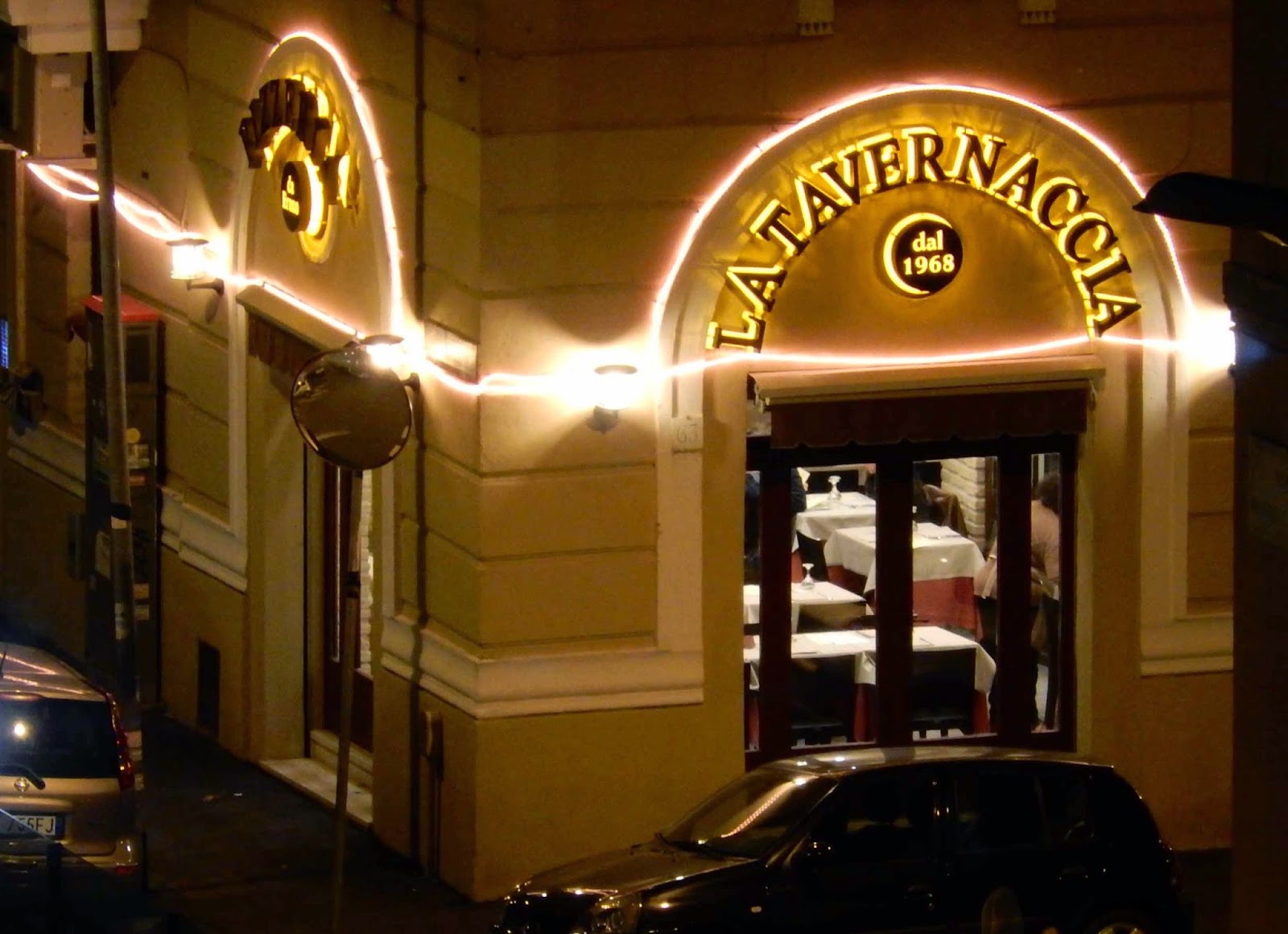
Chance (yay, chance team!) places us in our apartment in Trastavere across the street from La Tavernaccia, and we crawled over for dinner after the rigors of a travel and moving-in day.  Among many excellent offerings, we found lasagna.  L-team swung into action.

The lasagna, ordered by Nancy and tasted by Jean, was quite nice; Jean forgets why.  Still we love the restaurant. However, when we returned, no lasagna.  We may report back in the future—this is our home from home.  We will survive, it appears.

From our front window we can see our favorite Rome restaurant

The next day, a desperate lunch stop after wearing ourselves out on a tour of the Vatican — no lasagna.  Team was filled artistically and spiritually but physically down to the nubs.  A subset of the group went the following day to the Borghese Gallery and had lunch at a venerable Roman restaurant named Giovanni’s. Good reports of lunch in a restaurant filled with Roman businessmen.  No lasagna report, however.

Finally we had a chance to get all our questions answered about lasagna and many other foodie things at our “Cooking Classes in Rome” class on Friday.  Chatting about food, chopping, stirring and eating for the whole day—this is a great class if you are looking for one. 

The lowdown on lasagna is that it is not a Roman dish.  It grew in the US because of the large numbers of Italian migrants in the early 20th C -- but they were from such places as Bologna and Sicily.  Lasagna as we know it in the US has the red sauce of Bologna and the prep and ingredients of the people of Sicily, who created a great dish out of poverty food.  Ricotta, for example, was the undesirable leftovers from making the prized mozzarella.  Yay, immigrants! for creating a silk purse literally from a sow’s ear - but too bad for us in our search for lasagna.

 
Ingredients, but not for lasagna, at our cooking class. Jean with pumpkin flowers

In a couple days, though, chance again took us to a great lunch, this time in Orvieto — back in Tuscany.  The lasagna on the menu had spinach, ground beef, and béchamel sauce.  Trattoria del Moro restaurant, near the clock tower in Orvieto, wins our lasagna prize.
 
Julianne at Trattoria del Moro in Orvieto

Considering all the great food we have had and good restaurants we have chanced upon or found through research we all could have much more to say. Anon.  There are worse ways to spend time than chasing great lasagna.

by Julianne, with pictures by Nancy and Kitty

Sunday, October 26, 2014

Leaning in, Pisa-style

We have had one full day in Pisa, and we used it for just what you would expect - going to the Piazza dei Miracoli (aka Piazza del Duomo) and gaping at the Leaning Tower. Also, eating pizza. Also, walking about looking at other marvels, of which there are several.

It was fun, that's the first thing. We took a bus to the end of the line and there we were. The Piazza was full of people having a lovely time. They had the idea to right the tower. Hm. Some problems in performance...

Here's how to do it:
Obviously.

This tower is hopeless, however. It'll never straighten up. In fact, it's been slipping a little and there's been an effort to stabilize it further by pumping a new foundation underneath. You can see if you look closely that by the time it was 7 stories high, they realized it was tilting, and the little top layer is canted the other way in hopes of not making the problem worse. 

The Piazza has other buildings, all sheathed in limestone or marble. They are as white as if they never experienced air pollution. This may be true. Julianne thinks they sandblasted them, though. We didn't have the same opinion on this. I think the carvings are too crisp to have been sandblasted. Well, somebody knows this.


So much for the artifacts of bright pride. We walked into the city and ate pizza at Pizzeria Santa Maria, very charming. Walked toward the river, stopped in a bookstore, bought a book, got some ice cream, took more pictures. Nice day.


Transitions: Trains, boats and automobiles October 23-25, 2014


Transitions are part of travel.  Closing down one stage and opening another.  In between are trains, boats and automobiles.

As I think about saying good-bye to our kind host, Marta, in Tarragona as she took us to the train station I am reminded that I really like her and miss her.  This kind of travel in which we stay with folks opens a view of the world we enter in each place; then we turn our faces to the next place.  How much we have appreciated Gary and Jaap and Ananeke in previous locations.  This aspect of our journey has worked much better than we expected--a gift from the travel gods. (There must be such things.  Somewhere, maybe the Prado, was a great painting of St. Anthony.  Maybe he works on Air BnB too.)  We are meeting our friends, Jean and Cynthia, and my sister Kitty, in Florence on Monday.  Our small world will enlarge.  We are excited for the company--and this company in particular.  Yay!

But the time in between reminds that all travel is not peak experiences.

Train to Barcelona--beautiful views along the coast, crowded trains, our luggage taking up the aisle making others sidle around.  We packed light considering that we packed for a journey of a year or more.  It is not that light though.  Train trips are when we really notice it since we must get everything up and down train steps at least and maybe steps to platforms.  We are getting a relay routine down: train stops, we swing into action.  On the other hand, other passengers seem to help quite often. It is in their interest to get us out of the way too. Several willing hands at Barcelona Sants.

Hotel time in Barcelona.  We are spending down hotel points which I accrued on refugee circuit rides.  Six weeks here and there in chain hotels has added up even for me who was not that good at managing my points.  So a night in a Sheraton.  Halloween pumpkins for décor.  Business center.  City bus to the Ramblas for dinner. We are getting to be quite good on city transport systems. After superb paella along the coast, we really wanted--a hamburger!  Found it too in a Viennese cafe.  

On Friday--a ferry to Italy.
I have been known to drive 200 miles out of my way to take a ferry.  I was so excited to find that 8 different ferries go to Italy from Barcelona.  They go other places too.  During our first stay in Barcelona, we were looking down on the ferry dock.  Our tickets were Barcelona to Genoa. Be still, my heart!


The Friday morning reality was more stark.  The ferries are in the freight dock.  We were the only walk on passengers.  The relatively few other passengers drove on.  Our boat seemed to be transporting mainly new cars for sale. No one much knew what to do with us--police check point, unmanned.  We finally found someone.  A bus from the police point to the ferry--30 yards, only us.  Couldn’t get on yet--where can we wait?  Much back and forth--ask that person; no, that one.  No one spoke Spanish or English.  Eventually we entered.

Tickets for Pullman sleepers on the Sky deck, Rossini room; map showing restaurants, piano bar, swimming pool.  Sounds great. It is to laugh!

The Pullman sleepers are chairs that recline--a little.  We were in the Puccini room with about 30 men and 2 women who had gotten on in Morocco, the origin of our boat.  As far as I could make out, they are workers going together on some type of work contract.  They all had the same blankets, same food bowls and spoons. I am reminded of my flight from Jogyakarta to Kuala Lumpur on the bargain flight--me and 200 Indonesian men who work in Malaysia.

The piano bar was as much like a Middle Eastern coffee shop as anything I have experienced--men, women and children settled in for the long haul with tiny cups of coffee.  The piano was a climbing gym for the kids.  Most restaurants closed by the time we entered and got settled; some clearly never open, these days.

The swimming pool had no water, big net.  All the deck area around the pool was a shisha bar with several hookahs and tables of Moroccan men playing cards.

The Moroccans must have embarked in Tangier and must have been on the boat for at least one night.  Everywhere in the boat were little camps where folks had set up their blanket and food and clothes packets.  Reserved seats meant nothing--just as well as we got nice ones by the window instead of odd seats in the middle of the room. TV full of Arabic soap operas of family conflicts and love gone wrong, French language news, a long clerical lecture, and Bugs Bunny cartoons, also Popeye.

All our fellow passengers seemed wholesome, kindly people.  We had to get by with smiles as I have only 2 words of Arabic (oh why didn’t I pay more attention!). They seemed to have no words of Spanish or English.

There are cabins--why was I unable to get one?  Why did I think “Pullman” meant beds?  What was I doing when booking?  How could I do better?  If there is a next time, I will figure it out, I hope.

Beautiful sunny day out on the decks.  My hopes for seabirds of the open ocean came to naught as we hugged the coast of Spain going north.  Good views of the Pyrenees and coastal towns.  About 30 yellow legged gulls--no other birds.  3 fishing boats. 2 sail boats.  A container ship off in the distance.  An oil tanker off in the distance.  


Photo
Sunset over Spain.  After all there was a peak experience.

More sleep in the sleeping chairs than expected.  A line of 100 people for coffee.  Firm announcements that various categories of passengers must assemble in their assigned location by 6:30.  We who are “a pie” should be in the 7th floor lobby.  We are.  Everyone else has tickets for car deck C.  People tenderly stroking pets who have been in the pet accommodation. Where are the Moroccans who were in our sleeping room?  Surely they are “a pie” too.

Restful waiting.  Finally coffee.  And in one sip--”Presto, presto.  A pie.  Al assensor!!!”  Gulp, gulp.  And down and out to Italy.

Sunrise in Genoa--another peak experience.
Good thing as we had a long walk to the actual passport control and exit.  

Oh, a taxi to train station?  You have to call the taxi company.  Although there are few passengers on our ship, there is another ferry and a cruise ship--surely there could be a need for taxis?  Guess not.  Finally, we spy a Holiday Inn.  Their kindly call resulted in a taxi, short trip to the train station.  Time spent getting a “silver pass” for Nancy to get a train discount.  Tickets to Pisa and onward tickets to Firenze as we are learning to call it.  

The train and luggage thing again.  No elevators or escalators.  Very tall train with steep steps. Our relay system in action and kindly other passengers.  Our luggage in the aisle again.  Suitcase with 4 rolling wheels zooming down the aisle when the train moves--us chasing.  Continuing patient other passengers.

Stunning journey.  One of those unplanned good luck journeys.  The train hugs the coast as the terrain is very steep.  Lovely towns.  Where are the tacky parts of town that huddle along train tracks in the US?

Mediterranean to the right of us; mountains to the left.  Wow!  Look at those mountains.  Sharp peaks, way up there.  White tops on some.  Yikes--this it the area of Carrara marble and we see mountains of it being quarried, stacked, worked and ready to be shipped.  There are miles of these mountains--the world will not run out of Carrara marble in case you were worried.

Pisa Centrale.  Luggage and stairs thing again.  No elevator.  Relay.  Kindly other passengers stepping in from time to time.  Really, we are willing to pay porters if there were such a thing.  There is no such thing.  The few other travellers with much luggage, and in some cases children in tow, are doing the same as us--relay.  A strong guy with family and much luggage just added us to his relay routine.  (We carried one of the baby carriers. Laden mother is herding small children.)

Another points hotel--this time Marriott AC.  We zoom past the old city walls, 18th C. buildings to suburbia.  Hotel among suburban apartment blocks; mall a block away.  We were starving and so glad to see a mall.  Good food in a cafeteria.  Major suburban grocery store.  Delighted to get into our standard hotel room--soft beds, shower.  Good internet to take care of business.

Tonight we veg.  We might be getting a little old for the all-night-in-seats approach.  The train luggage relay is already old.  Tomorrow we will have time to find the historic center, leaning tower.  Back to peak experiences and soon--friends.