Sunday, August 16, 2015

The Glasgow Miracle: City Revitalization through Art


Curiosity takes me to odd spots.  What could it be--The Glasgow Miracle--that I am hearing and reading about?

The query led me into some interesting conversations and finally to a walking tour sponsored by the Glasgow School of Art.  Since I have been interested in the GSA and its historical artistic prowess, I have been wondering about its current teaching and scope. Here was my chance to understand the current art scene in its relationship to place.  Yay!

A curator now at the Tate Britain, Hans Ulrich Obrist, called the artistic achievement of Glasgow The Glasgow Miracle, recognizing the excellent art (of all media) produced here and recognizing that there is a lot of good art relative to the size and economy of Glasgow.  It seems to me that folks in Glasgow take it a bit further in recognition of the long slog of hard work that has resulted in the artistic achievement.

So anyway--the Miracle is the abundance of cutting-edge, world-class art produced in a small city with a moderate economy.

I am curious about how they did it, what the art looks or sounds like and what the artists think about what they are doing.  I am a social anthropologist--I do not believe that it is a miracle from nowhere, I think there must be factors which allowed for and led to the phenomenon. And I think is is fun to explore the idea.

Thoughts on How? and Why?
I had opportunity to talk to several former and current GSA students and my host is a writer who was raised here and has returned recently.  Plus, I have had several days to poke around.  I have come to a few conclusions on the factors which contributed to the Miracle.

The earlier prominence of Glasgow in the arts rested on the great wealth that flowed here with the industrial revolution.  Glasgow was one of the manufacturing hubs of the British empire and the city flourished.  Some of the wealth of the city was channeled into the arts institutions which remain strong today particularly the GSA.  From the mid-1800's to now, thousands of graduates emerged from the GSA including many like CR Mackintosh who completed their work in night classes over many years.  Art was a respected activity for men and women of all classes.  The socialist and labor philosophy which saw art as a redemptive activity for the workers and which prized the beauty of utilitarian objects was a major cultural norm here from early days.  Many of the GSA graduates remained living and working in Glasgow, often in other professions. The soil was fertile.

As the city declined in the post-industrial economy, the thinking of the cadre of artists contributed to Glasgow's direction.  GSA continued to produce hundreds of graduates dedicated to the beauty of utilitarian objects.  Real estate was so cheap that art space was plentiful (and seems to remain so now).  Arts organizations could find offices and set up galleries.  Artists were employed in social programs. The Third Eye Center employed many artists and was dedicated to community organizing.

In 1990, Glasgow was designated the European City of Culture.  Even Glaswegians were surprised to find out about their artistic wealth and began to take themselves more seriously. The term Glasgow Miracle, coined in 1996, rose from Europe's new awareness of Glasgow.  So on they have gone.

Rent remains affordable for studio space and for living space. There are other artists, writers around, GSA continues to produce prize-winning graduates.  Importantly, in my mind, the UK is really prosperous and Scotland as much as anywhere.  The North Sea oil services and money flow to the whole country but Scotland services much of the effort.  It looks really prosperous everywhere I have been so far. Graduate artists can, and seem to want to stay here to pursue their careers.  Good for them.

Hard to say how the future will unfold.  But, I think that once things get going, they continue along, so maybe the miracle will continue.  Glasgow would surely be a good place for an art-inclined person to spent some time finding out more.  Beautiful city, great food, lots to do.

The current trends in art may be somewhat counter to the previous trends which contributed to the Miracle.  The prize winners and all students are guided along a course which emphasized transient work which disappears--standing on a pedestal like the statues in George Square, for example. My student acquaintances seemed to have little interest in community action as their predecessors had. Rather, some are fully engaged in the ironic, self-referential art such as the Empire sign. No doubt, the ironic approach to art reflects wider trends in the world too.  But it will be interesting to watch whether such work will maintain general public interest and how it will fit the wider Glasgow art scene.  Maybe there is enough here to ride out the current trend until something more accessible to ordinary people emerges.


What does the Miracle art it look like


I think this piece captures several aspects of Glasgow cutting edge art.  We could only view it through a locked gate so we have a shot of the whole alley--probably appropriate.  The mural is not the art in question but rather the piece reading Empire backwards further down the alley.  The sign is by the Turnerprize-winning artist, Douglas Gordon who studies at GSA and has moved on in fame and fortune.  The sign has layers of irony and self-reference--Glasgow's past as a bastion of the British Empire, Hitchcock's film Vertigo, and probably more.  Originally it was erected in a more accessible location but is now hidden so it feels like we are "in the know" about this kind of secret art work.

The mural is not thought to be of any particular distinction--our guide knew nothing about it. Glasgow has no street art such as we became aware of in Rome and very little graffiti of any kind.This mural is known--it was created for the Commonwealth games held in 2014.  It is longer than I could capture.  Its subject matter is long on animals.


This statue of Wellington is from the height of the empire but has been given a Glasgow twist.  For awhile the city tried to keep the hat removed but there is always another traffic cone and another youth to climb up and put it on.  Now Glasgow has embraced the image. It is standing in front of the Glasgow Gallery of Modern Art where a current Turner-prize film maker has films showing. Wellington is looking down the street where the backwards Empire sign is hidden.  Probably not intentional.


Poetry and the written word
Here is poetry carved into the sidewalk: Concrete Poetry by Edwin Morgan.


Poetry posters are erected in a few places--sadly getting a bit faded.


Building detail
All over the city, there is building detail of this kind.  In fact, I can't think of any place that had chain lin fencing or utilitarian grids.  The top is an un-named parking garage. The lower is a bulletin board at University of Strathclyde.


Early days of the City Revitalization
After the end of WWII, Glasgow experienced a severe and rapid de-industrialization at the same time as its population had reached 1,000,000. The city administration undertook urban renewal via slum clearance and building highways with little thought to the visual or social consequences.  This story sounds familiar to most of us in the United States and we are currently trying to get rid of the results of misguided efforts in some places.

In Glasgow, the effort seems to have better results.  Slums were cleared but the many visually and socially inclined students and graduates of GSA seem to have had beneficial effects and probably set the stage for the future Glasgow miracle.  The Third Eye Center was established in 1974, still going on but under the name of Center for Contemporary Arts, had an outsized impact on the environment of the city.

This playground stands on the site of former housing like the buildings in the background.  GSA students and graduates worked with the remaining community members to develop this park which is near GSA in Garnet Hill.

The painted design on the building end is faded but the mosaic mural behind the slide remains in good condition.

The families who lost their housing or were too crowded, moved into these high rize towers which ring Glasgow.  It is a small city so this building is within walking distance of city center.  It is used now and remains in good condition.  The Third Eye Center worked with the inhabitants of these estates to work together to create murals, landscaping and create community.  It seems successfully, since the structures remain and are in good repair.


Performing arts
It is August and all performance efforts are at the Edinburgh Festival and the Edinburgh fringe.  I have little to say about content and quality.  But this shot captures some of the interest in performance.  The Theatre Royal is the oldest performance space in Glasgow--a representative of the cultural ambiance at the height of empire.  The spires in the background are a recent addition in a very different architectural style.  In fact, if I were a better photographer, if it had not been raining, etc., you could see in one frame several architectural styles working together harmoniously.  This is common throughout the city.  I think the relatively low heights probably helps maintain visual harmony.


This building is about 5 stories tall and near the previously pictured ones.  It has won a prize of a different sort: The Carbuncle Prize.  I do not recall the year but recently it won the prize conferred for the ugliest building in the UK. It is a movie theatre.  I did not find it that offensive but I get a kick our of there even being such a prize.


Maintaining the mix of old and new
Our tour ended here, an area which is called the trongate. The medieval buildings here are the earliest surviving in Glasgow.  The reddish tower is there goods were weighed and taxed when coming into the city for market.  It is now a theatre and houses art organizations.  The building on the left houses painters and printmakers studios. GSA graduates or other artists can rent space here for relatively little money and are able to maintain their studios and livelihood because of the abundance of this kind of space and the low cost of living here.


Wednesday, August 12, 2015

Charles Rennie Mackintosh and the Glasgow School of Art--August 12


The Arts and Crafts Movement of the later 1800's through the Art Noveau to the Art Deco movements of the early 20th C. are styles I enjoy immensely.  I am drawn to the architecture, to the practical and decorative objects and the philosophy.

Clearly, Glasgow is one of my artistic homes.  The city has reached pinnacles in these related styles, all exemplified by the Glasgow School of Art,  The central building of GSA was designed by Charles Rennie Mackintosh and built over several decades spanning my much loved art styles.  It is not a static institution--it has a 1970's "brutalist" building of cast concrete and now has an even newer building opened during the last year and built in current architectural style. (I am not sure if the current style has a name.)

Sadly, the famous Mackintosh Building burned last spring, just before the student show destroying half the building and most of the student work.  My visit could not include a tour of the famous library or other parts of the old building--it is totally closed for restoration.  When Nancy, Kitty and I were here in 2005, we did tour the building so I can recall many of the beautiful room and detail.

On the bright side, all the plans exist, multiple photos exist, so the building can be and will be restored as it was before the fire but with updated wiring and other important 21st C. features.

Mackintosh Building on the right. The west end under scaffolding burned.
The building on the right is the newest building, the Reid Bldg, opened last year.

Mackintosh was a junior staffer at the firm which won the design competition for the new building in 1897.  His wining design was firmly grounded in the Arts and Crafts Movement which was much appreciated in the GSA at the time.  The underlying philosophy of the movement stressed the beauty of utilitarian objects and the belief that the common person should have access to and be enriched by beautiful design.  Thus the building and its interior fittings reflected that belief.  This philosophy fits in well in Glasgow--a city which respects labor and the common man.


These two photos show the main door and the windows just east of the door.  The details of the light fixtures, fence, windows and ironwork show the attention to detail of the whole environment which was carried out inside as well.  The building is made of locally quarried sandstone.  Respect for the intrinsic properties of materials is another philosophical principle of the movement which also carried on through to the mid-20th C. in the school buildings and the school teachings.  The building was built from east to west as money was raised.  Over the period, Mackintosh's designs moved into Art Noveau and Art Deco so the west end, now burned was stylistically different though related to the east end.

Come back in five years.  It will be ready for your visit, restored to all its former glory.

In the meantime, the school continues to educate students in all aspects of art and design.  The newest building, the Reid Building, is directly across the street to the north.  It is a contrast in some ways stylistically and I was fully prepared to dislike the building.  But, wrong... I liked it very much and came to appreciate that much of its underlying approach reflected Mackintosh's approach.

This building uses concrete, stone and glass to manage light and space in much the way Mackintosh approached the same tasks.  To outward apperances, very different buildings but upon closer looks, similarities.

The outer shell of the building is primarily an opaque glass wall with windows of the same tone. Light from both the windows and walls suffuses the interior.


The interior is primarily reserved for student use but some areas are accessible.  We were able to enter and go up to the 3rd floor for a display of Mackintosh-designed furniture.

The first photo here shows the main stairway, railings and one of the major light shafts.  The use of light, curves, and angles shows well in this photo.  The use of greenish glass for the stair rails and balcony rails shows better in person.


This photo is taken from above, looking down three floors through one of the circular light shafts to one of the spaces for students to meet, confer, whatever.  The windows in the shafts and other interior, but not exterior windows are of this style with the top narrower than the bottom.  The primary arts taught in this building have to do with computer ad electronic design, media presentation.


While many of the decorative items and furniture were destroyed in the fire, some remained.  A few key examples are on display in the Reid building for tour groups.

The top photo shows a cabinet about 8 feet wide and 6 tall. The second photo is a detail from the doors showing the stylistic rose which has become a hallmark of Mackintosh design and is used frequently in decorative objects.  The cabinet is of oak and originally had shelves in the lower spaces.
The roses are leaded glass.  It was designed and build in about 1900 showing the transition between more rectilinear Arts and Crafts style and later Art Noveau.


This chair is of the same era-1899.  The chair was designed by Mackintosh but for the Willow Tea Room, a nearby business for which he designed the interior and fittings.


The Willow Tea Room still exists and still serves delicious afternoon tea. It is just a few blocks away from the GSA--perfect for after-tour tea.  Notice the detail in the balcony with upright railings balanced by horizontal design in the walls and windows behind.  A calming, peaceful room.


Delicious old-fashioned food too.  My lunch: leek and potato soup with oat cakes.  Fresh ground coffee. (I just can't get with tea so the good coffee is much appreciated.)


AND  Lemon Meringue Pie for dessert,  Yay!  My first in Scotland.
Excellent.  Made in little individual pie shells; sweet, tart, served with cream.  I am channeling Ballintoy, Northern Ireland.  Great stuff.


Shetland and on to Aberdeen


Driving around day.  Great birding in the morning.  Then exploring some parts of the Geopark in the afternoon.  The whole of Shetland Islands are a UNESCO-designated geopark because of the variety and significance of the geology exposed there.  It is just kind of beginning in terms of public interpretation but some aspects are accessible.

The big story is that there are plates pushing against each other which have pushed up and created the Shetlands including Fair Isle.  The north/south ridges of the islands are the peaks of the plates and have carried up a wide variety of  rock of different eons.

Here are some photos of the geology.  It was pretty poor weather in the afternoon so I could not get photos of everything I saw but had a great time anyway.
My car parked in front of one of the major fault lines. Shetland is the top of the ridges separating
 the North Atlantic and North Sea, 2 major plates coming together and creating the Shetlands.


Narrow part of island; 30 yards between North Sea and Atlantic.  Same fault line in the background. This narrow passage has also been a major route for people and otters to move between the N. Sea and Atlantic.


Esha Ness, remains of volcanic core. Glorious scenery, a lighthouse too.  Hardly any birds.  What's up with that?

Meteor crater on west side of Shetland


Shetland pony and friend. 

I was excited about taking a boat cruise from Lerwick that has an underwater camera to see diving seabirds and other underwater things.  Only the short cruise in the harbor was available so no diving birds but we did see seals, a wreck and many creatures growing on pilings. OK enough; not sure I would do it again.  Saw bids but not diving under the water which I had hoped for. Big highlight for me was seeing 2 red-throated loons.


Submarine camera to view seals, wrecks or other underwater things.
It is about 2 feet square.

Sea anemones under Lerwick Harbor

 A curiosity. Unlike Ireland where poetry jumps out at you everywhere, it is not omnipresent here.  But a poetry contest using the Scottish tongue a few years ago has resulted in Bards in the Bog.  The bog means the toilet so we could have our private poetry moment many different places.
Poetry in the toilet stalls

Fiddle Festival.

I really can't plan these things.  Part of traveling is enjoying what is happening at the time.  But my good luck was to be back in Shetland for the last part of the Fiddle Festival which is becoming an annual event.  It is focused on workshops for those wanting to improve their skills and included guitars, accordions and a few other instruments.

I went to the closing concert in the main concert and entertainment venue in Lerwick.  I am sorry that I missed the big dance party the evening before but it was very far north--too far for me.  The Saturday concert was grand.  It started with most of the musicians and students who had worked together and taught all week playing together to open the evening. What fun.  Then they dispersed into the audience so we all chatted about their week.  The rest of the concert was groups of Shetland fiddlers--good music and good craic (fun chat).


Then, to my surprise and delight, many of the same folks were on the Northlink Ferry on Sunday, returning to Aberdeen. So we had sessions in the bar on the ferry with as many as 10-12 musicians participating.  A great evening entertainment for me.


Tuesday, August 11, 2015

Irish Art: Continuity and Adaptation from the Stone Age to the Present


Gold, bronze, silver. Ceramic.  The written word. Grand items laid our for our viewing pleasure at the National Museum of Ireland and at Trinity College, Dublin.  These are not very large venues but so filled with exceptional items that we had to visit several times during our stay in Dublin, our last Irish stop. We appreciated the excellent displays and layout too.  Seeing so many beautiful items in one place leads me to a reflection on Irish art through the ages as I have been seeing it these last few months. Finally seeing the Book of Kells (above) with time to appreciate the beauty and skill of the manuscript--priceless.

For us, it was fun to find the treasures from the areas we have visited.  Kind of like finding an old friend to see the real Celtic golden neck ring after seeing the reproduction in the Burren Museum in Kilfenora.


The National Museum also has a full size reproduction of the church door from Dysert O'Dea church which was active from the 700's to the Cromwell era..  We feel like it was sort of our secret church since it was actually hard to find, we were totally alone out there in the cold and rain and we came upon the carvings suddenly.  We felt like jungle explorers who looked up and saw the beauty of the church; thus, glad to see the reproduction of the doorway again in Dublin.


Dysert O'Dea Church near Corofin, southern edge of Burren


We also found treasures from New Grange where we had poked around and had gone inside the graves. The real Book of Kells is in Dublin but we had the pleasure of wandering what is left of the monastery in Kells town.

Keeping Dublin for last turned out to be a good idea.  The museum cannot and does not try to show the megaliths, church and monastery ruins, ancient graves.  We have poked around all those things to our heart's content and now could see the small treasures associated with the sites.

Why here and why now?
Always my constant question as we wander.  It does become clear that there are places which have exceptional visual or other arts during some times compared with the same place at other times or compared with other places at the same time. (Did I really write this sentence?  Can my meaning become clear? Sigh!)  What about Ireland?  Artistic high points?  When and where?

Upon reflection, I see two eras which are high points for me with much other supporting fine art and architecture from other times.  I am sure there are actual art experts and scholars who have refined ideas about this and maybe I will get to them.  But from wandering and looking at lots of ruins and artifacts, this is what I am thinking now.

Neolithic Era and Early Medieval Ireland-High points of aesthetics and skill
The New Grange complex from about 6000 years ago (neolithic or stone age) appears to me to be an artistic high point for Ireland but also for the whole western European stone age period.  Later, but with artistic continuities, the Celtic people of the early middle ages (about 600-900) produced metalwork, buildings and manuscripts such as the Book of Kells. These periods show skill and refinement of technique as well as an aesthetic sense that thrills my heart. I particularly enjoy these periods but the times before and after show artistic continuity; the museums and historic sites have fine examples of work from all periods.

Neolithic--New Grange Complex
New Grange is the overall name for a large area which includes New Grange itself, Knowth (both open to visitors) and about 40 other monuments and stone circles. The whole complex is magnificent for its engineering and social complexity.  Passages to the center are built so that light enters at the solstices or equinoxes, for example. But I am stunned by the visuals which seem unmatched by their contemporaries in the Neolithic world.  I will have a chance to look at more sites in Scotland, Wales and England.  We got good looks at the related megalithic complexes in Brittany.  Nothing else has the sheer number of carved stones as part of the grave and ceremonial sites.  Locmariaquer in France is the only other site with carved stones that we have seen, in fact. I will miss the relatively new discoveries at the Ness of Brodgar in Orkney so it seems clear I will have other travels in the future to check my current conclusions  But the aesthetic thrill of New Grange will always remain.

When we entered Brittany in France, we artistically left the Roman empire, the Renaissance, Baroque and dropped back in time to the Neolithic era--Stonehenge and its predecessors.  Many sites in the area around Carnac have incredible stone structures.  Upon arriving in Ireland, the stone monuments are both related and different.  The builders of the complex structures across much of western Europe clearly shared aspects of culture.  The miles of aligned standing stones in Carnac are seen no where else. However, the complexity of engineering and the artistic care taken at the New Grange Complex in Ireland seems to me like the high point of accomplishment of the neolithic farming peoples who moved into Ireland about 6-7,000 years ago from origins in the middle east.

Not only does the New Grange complex have a lot of carving, it is beautiful.  Large stones--4 feet by 5 feet or so--have compositions of spirals, circles and lines which exhibit balance in composition.  A clear aesthetic sensibility was at work.  Beauty was clearly valued. Around the outside of the main structure are 27 carved stones which have remained in place since originally put there. Restoration has made them visible but they remain as placed millennia ago.


All the above are from Knowth and New Grange

For comparison, I am including the following are web images for Gavrinis tomb in Brittany, France, on an island near Locmariaquer.  In order to protect the inside of the tomb where the carvings are, we had to check our bags and could not carry cameras.  The following photos are from French Government sources.

Outside of tomb.  It remained unfinished.


I do not know if the stones at either site were originally painted.  At New Grange there is evidence of effort to use black and white stones for aesthetic purposes although it is not known how they were placed. The current reconstruction efforts at the two restored graves are not that successful.  One related site in Spain shows some megalithic carvings with traces of paint so maybe more will eventually be known about use of color in such carvings. (Maybe we will get to see it when we get back to Spain next fall. Not sure it is open to the public.)

The recent discoveries in Orkney of the Ness of Brodgar Ceremonial complex is giving scholars new ways of thinking about the neolithic. It appears that painting and carving were used there and dating gives a very early time frame.  When that site is better understood, more light may be shed on New Grange as well as the sites are roughly contemporary.

But, in my observation, New Grange complex shows a height of artistic achievement for the whole European neolithic.  It was so exciting to be there after the also magnificent stone alignments and other structures at Carnac in Brittany. Stonehenge is modest by comparison and much later but is stunning for the sheer size of the standing stones. New Grange has standing stones around the main structure but they are dwarfed by those at Stonehenge and dwarfed also by the New Grange grave/ceremonial structure itself. Visiting these and other neolithic sites gives a strong sense of the sophistication of the societies.  Seeing them spread across so much of western Europe highlights the communication and travel that must have been happening 5-7,000 years ago.

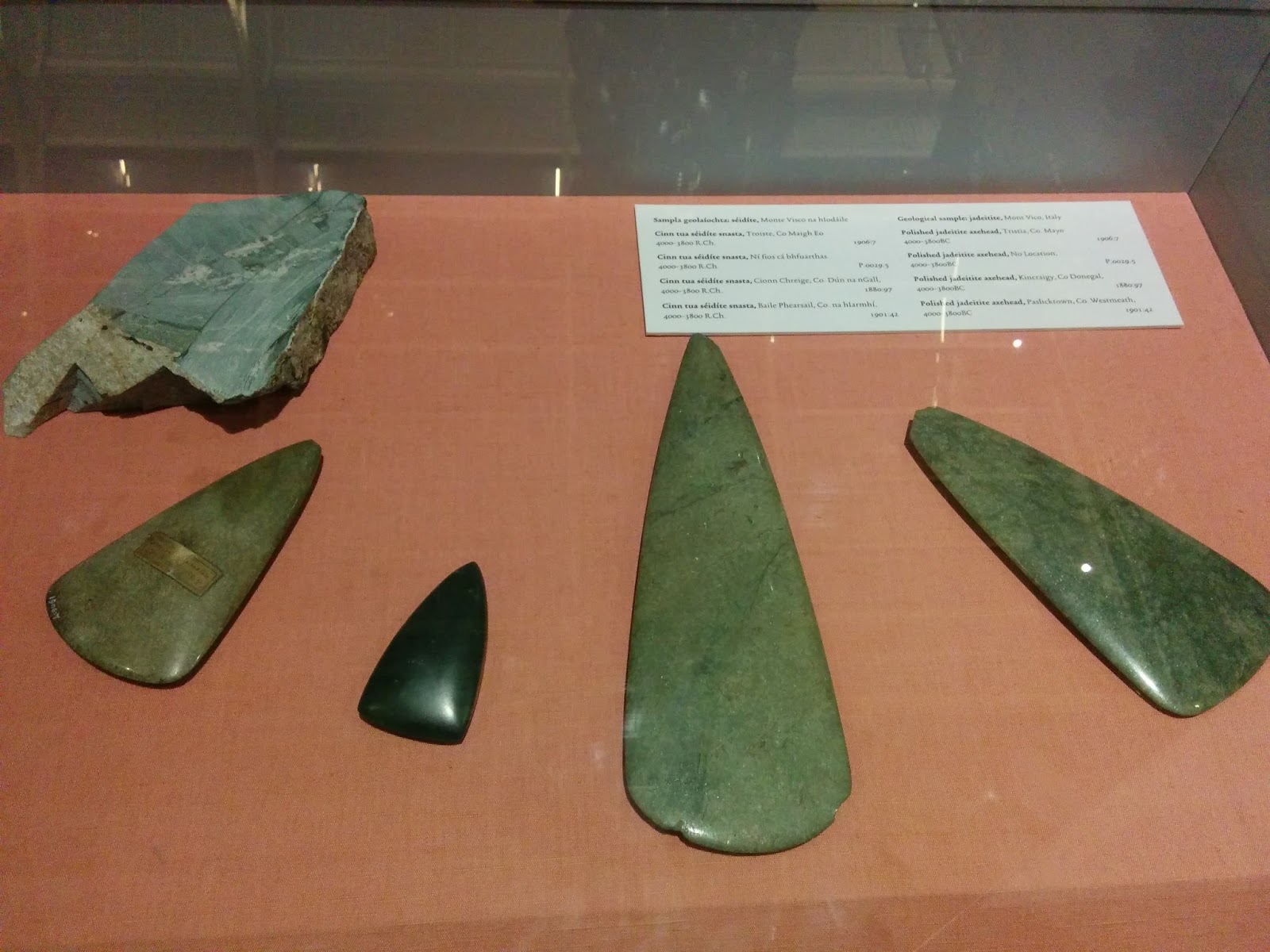
Trade in beautiful jade axes connects the Breton sites with New Grange and with other Neolithic sites in western Europe. The raw material for these axe heads comes from the Italian Dolomite mountains. They were never used for work and are thought to be a high status trade item.  The long ones are about 8-10" long.  I found them so lovely that I kept returning to look at them in both museums.
Jade Axes in National Museum In Dublin,
found in the New Grange area.

Jade axes from French museum in Carnac, Brittany
Bronze Age and Iron Age
The bronze age and early iron ages in Ireland show increasing skill in use of materials and building. It seems that there was a climate cooling as western Europe entered the bronze age so in Ireland, population diminished, society became less complex, more local.  For example, the Burren area in county Clare where we did much of our poking around was largely uninhabited during the bronze and early iron ages (2500 BC to 300 AD more or less.)  Other places were inhabited but showed less complexity of society.  On the other hand a major technological revolution had taken place; metal implements made hunting and farming more productive. Technology and skill took leaps in ceramics--see my favorite jar (below) from about 2500 BC.

Having metal tools, makes such a difference artistically.  The bronze age artifacts alone are stunning. These photos are of bronze age artifacts--about 2500 BC. The bronze tools were found all together in a "hoard" dug up from a bog.  The ceramic jar was from a burial site in Co. Mayo.


The iron age means the entry to Ireland of the Celtic people who were also spreading all around western Europe.  Around 6-500 BC they were devastating northern Italy as we saw when we visited the National Museum at Adria, Italy.  Link to our earlier blog post about Adria here.  The Celtic people entered Ireland around 400 BC.  There appears little evidence of warfare in the early days so the assumption is that there was a mixing of old and new populations.  These guys were excellent metal smiths and the technology of the farmers in Ireland really took off.  Iron plows, animal harnesses and similar implements abound. However, it seems that they continued to use bronze for much of their decorative work.

This disk is about 15" across and from about 300 BC. The motif in the center is common from New Grange through the Medieval period.

Christian Medieval Art
The other period of Irish art which never fails to thrill me is the medieval period from about 600-900. As Germanic peoples began migration throughout western Europe, the Roman empire withdrew leaving much of Europe and England in chaos for several centuries.  Ireland appears to have had a population influx of Celtic Britons who were being squeezed out of their previous homeland.  Many of those same peoples migrated to Brittany which had emptied out after the demise of the Roman empire. In Ireland, farming people spread across the land.  The marginal land in the Burren was again fully populated.  Iron age farming and herding was more efficient and able to support the increased population.

Christianity was present in Ireland from contact with the Roman empire but increased to become the major religion after St. Patrick entered to preach and establish the church in the mid 400's. With Christianity came writing and reverence for the written word.

Artistically, the convergence of skilled artisans, increased population with more complex social structures, writing and the production of religious books led to an artistic high point.  Wealth allowed leaders to employ skilled artists. Christianity set up churches and monasteries which encouraged aesthetic expression in stone carving. The monasteries were scholastic centers which were dedicated to the spread of learning including the copying of manuscripts. Religious ritual as well as secular display encouraged fine metal work. Written gospels and other parts of the Bible were produced for teaching and eventually used for reintroducing Christianity to some other areas of Europe.

It is thrilling to see the metal work and manuscripts from the period of about 600-900.  While there is a continuity of motif and design from earlier eras, these reach a high point of skill and aesthetic refinement.  In the National Museum and at Trinity College, the displays allow the beauty of the era to shine.  Lucky us.  All we have to do is show up.

A page of the Book of Kells, written in about 905.

The Brooch of Tara, gold and silver, about 6" across.

Text from the Fadden More Psalter, recently found in Co. Tipperary. Written about 800.
Embossed leather cover of the Fadden More Psalter
These carved stone crosses are from the original monastery at Kells, northwest of Dublin.


Viking Influence
Viking raiders began affecting Ireland about 900.  Monasteries were under pressure and many manuscripts and other items were lost. Political and social structures were similarly stressed.  Artistic work suffered,  artisans could not maintain the previous excellence but did continue and gradually incorporated the new influence in their work. Within a couple hundred years, the Vikings began settling in towns and established trading centers.  Dublin, Wicklow and Wexford were Viking ports. Viking motifs were incorporated into Irish art, especially metal work and also in some of the motifs in the ornamentation of manuscripts.  After contact with the Vikings, the artisans incorporated animal heads into their twined and spiral designs but the overall style remained a continuation of the earlier work. Vikings introduced silver so Irish art began to use combination of gold and silver.

This bishop's crook shows the use of silver but with continuity of motif.  From about 1050 after Vikings had settled and had begun to integrate with the local populations.

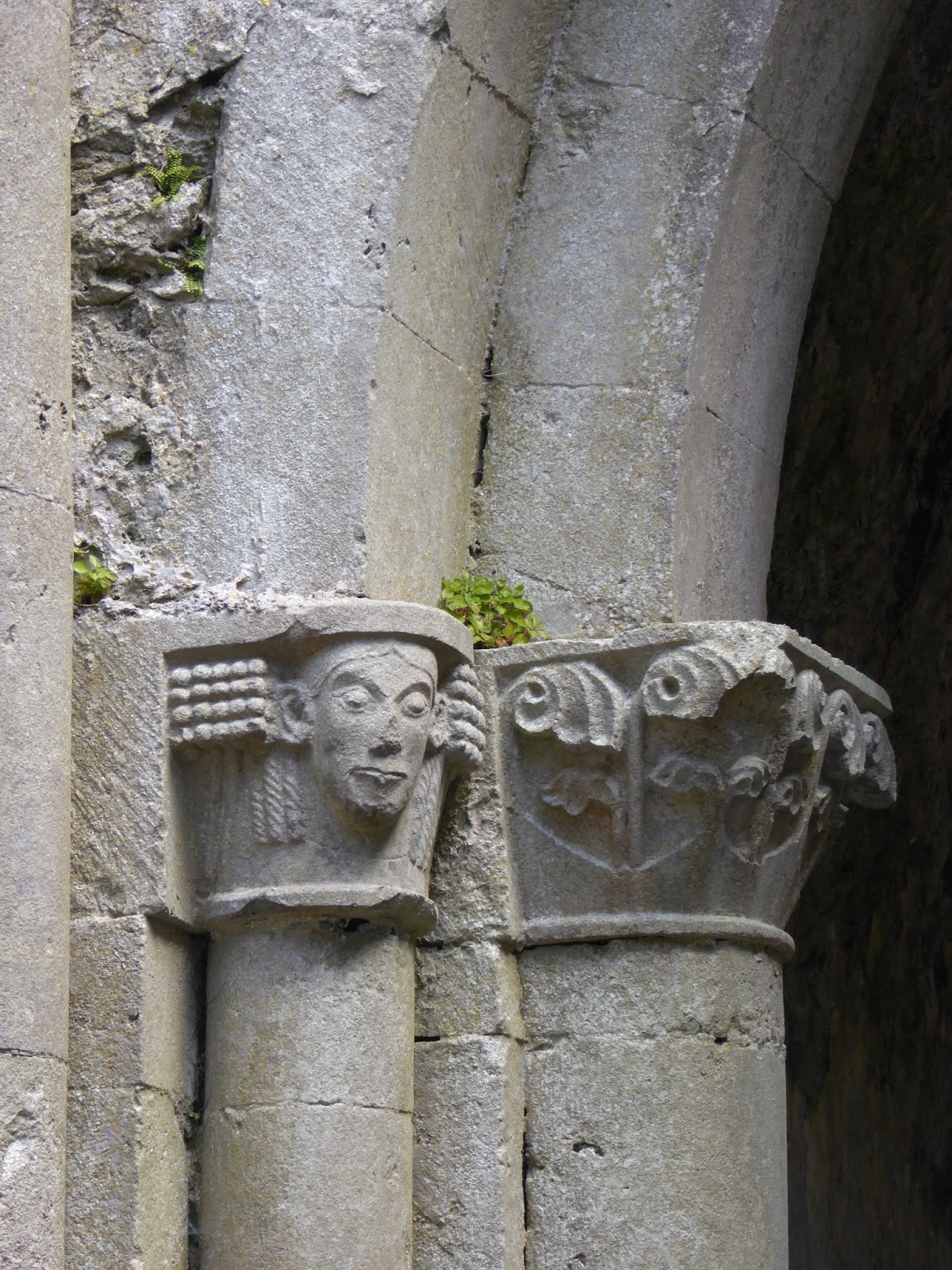
As Europe began to recover and establish cities and trading networks, Ireland was also drawn into the Medieval world. The British-Normans entered Ireland and successfully colonized most of the country. They brought the Roman church which eventually replaced the earlier rituals and governance of the Irish church.  Cistercian and other European religious orders entered and the Gothic building style began to be used for churches and other public buildings.  Artistic styles reflected the changes.  Earlier religious items such as bells and gospels were revered and encased in decorated shrines.  See our earlier blog about St. Conan's Bell to see the original bell with a Viking style handle and a Norman case. New churches were built in this period and existing churches redecorated.  It is common to find stone churches from earlier periods with a Gothic style door or window as though the church leaders were wanting to adopt some of the new modern style without actually rebuilding the whole church.


The top photo is the Church of Ireland in Galway.  Originally built by the Normans they used gothic arches for the structure when they created their city of Galway. It was re-purposed as a Protestant Church after Cromwell.  It remains in use today and hosts traditional Irish music weekly.

The next two photos show one of the very oldest stone churches,Temple Cronin in the Burren in Co. Clare. It can be dated to the 800's by the window which is narrower at the top but there was a monastic community there from the 500's. It continued in use and has a gothic style window added later.  Its interesting carvings are so weathered that I could not capture them.  The church was destroyed under Cromwell and is deserted since then.

These two photos are carved detail on Temple Cronin.


Here also are some shots from Corcomroe Abbey, which was established about the same time as the church in Galway--1100-1200.  It was built in the Gothic style by Benedictines who introduced Roman-style Christianity to Ireland, replacing the earlier Irish/Celtic church. Also destroyed under Cromwell but not re-purposed like the Galway church.


Corcomroe with me, contemplating Irish art.


 The last specifically Irish art


This Cross of Cong is from the 12th C, shortly before the Norman-British entry into Ireland.  It is one of the latest items of the "Irish" style in the museum.  It is about 2-3 feet high and originally contained a relic of the true cross in the center crystal.  I enjoyed spending quite a bit of time looking at the gold,silver scroll work with animal heads and much curvilinear design.

For comparison of style continuity, the photos below are from a cross of the 5th century. It is about 2 feet high.


Little evidence of renaissance, baroque in Ireland
By the time the Renaissance began to spread from Italy to western Europe, Ireland was mired in the religious and governance conflicts of the Protestant reformation in England.  Henry VIII and Cromwell made great efforts to subdue the unruly island.  Thus, artistic expression was limited with music and literary arts going underground, some religious artifacts going into hiding as did the Bell of St. Conan. As the Republic was formed in the mid-20th C, efforts at artistic revitalization have taken root. Crafts, dance, music and other arts appear to be thriving with emphasis on returning to Celtic roots. But that story is too complex for me to reflect on in this little blog; it could be a story for another day.

Medieval cross still in place in Kilfenora, Co. Clare. Previously a monastery, now a pasture.
Text by Julianne.
Photos by Julianne and Nancy,
except the French government photos of Gavrinis.