Monday, March 9, 2015

Tosca: One Great Night at the Opera and One Great Wander in Rome

Loving but jealous heroine, faithful and honorable hero, evil villain -- everyone in Tosca dies singing some of the loveliest music ever written.

Listen while you read:   Vissi d'Arte sung by Maria Callas


Ourselves wandering to the buildings used as settings for Tosca, which Puccini set in Rome.


Tosca premiered in Rome at Teatro Constanzi in 1900. Last night in the same theater, we heard Opera Roma perform a production based on the original 1900 world premier.  Puccini set his story in Rome, and specifically identified the locations of each act. Today, we had the pleasure of wandering Rome to see the buildings where the three acts were set.  Tourism doesn't get any better than this.

Waiting for Tosca to begin in the same theater where it premiered

Tosca remains one of my favorite operas.  The music, like other Puccini music, is deeply satisfying with near harmony, reprises of themes for each character, duets and arias which have become part of the canon for opera lovers.  I wish I had the knowledge and words to describe the musical techniques that Puccini uses so well in this opera; the music reflects and explores the complex moralities of each character.  The rising/falling of the orchestra and voices and their play off each other pull us into the tension between good and evil and between differing forms of good.

I enjoy how the music, character, plot and lyrics all carry the theme in a way that is rarely achieved in any art.  I enjoyed even more that this production recreates the original premier and that each act is set in a recognizable building in Rome. 

Act 1--Sant'Andrea della Valle
In this production the sets and costumes also further the dramatic tension.  The first act in the Baroque Church of Sant'Andrea della Valle introduces the moralities of Tosca and Mario--moralities which are both "good" but have different bases. Hers is based in traditional religion as well as emotion and love; his is based in the politics and concepts of individual freedom. The conflict of their moralities drives the tension and the drama to its denoument.

I do not know if Puccini chose Sant'Andrea specifically to illustrate the tension between secular and religious morality, but he surely set the act in a church to make his point.  Sant'Andrea is not that well-known as a church in Rome; none of its art is recognized as rising above the ordinary baroque of the day.  But Act 1 is set there and the gated Barberini chapel is crucial to the scene of Mario's friend escaping from prison as a traitorous Bonapartist. The irony of the secular Bonapartist turning to a religious venue for help is intended.

We had a glorious visit this afternoon.  Western sunlight was illuminating the golden mosaics and the shiny pipes of the organ.  Maybe it was better that we did not have any specific outstanding paintings to absorb and could appreciate the light, composition and spaciousness of a baroque church with Tosca and Mario's duet in our mind's ear.

Baroque church Sant'Andrea della Valle

Gated chapel, setting for action in Tosca.

Deep three note musical theme:  Scarpia enters the church and plays upon Tosca's love and jealousy.  What a guy!  Surely the personification of evil.  Dressed in strong contrasting black, white and red his costume overpowers Tosca's blue filmy dress, even as he overpowers her emotions.

It turns out that Scarpia has only a few blocks to walk from the church to his home in the Farnese Palace, actually now the French embassy and a French stronghold in Rome for many years.  The second act is set in Scarpia's apartment and office there.  Again, it is not clear to me whether the building was chosen to illustrate the Bonapartist/monarchist divide or it was a convenient, beautiful building.  The actual king referred to in the drama is the Bourbon king of Naples at the time the drama is set in the early 1800's. Nothing is exact; this is fiction.

Act 2--Farnese Palace
The second act, set in the Farnese Palace, is a duel between Scarpia's evil and Tosca's strength.  She keeps the upper hand in morality and emotion and conquers him, finally killing him to save Mario.  Her aria, Vissi d'Arte is my all time favorite piece of opera music.  She asks God: "I have lived for art and love. Why have you forsaken me.  I have led a moral life--giving to the poor, supporting the church, using the gift for song that You bestowed upon me. Why must I face these terrible things?"  I have to say the English super-titles in this production did not do justice to the content of this aria.

We visited the Farnese palace which is a harmonious Renaissance architectural composition.  Partly because we can see it across a wide piazza, we can appreciate its balance.  The French keep it up nicely too.  The Italian soldiers at the embassy gate, of course, don't let in wandering tourists.  We have no idea which windows were Scarpia's so we let our imaginations wander.  The nearby Palazzo Spada, which was open to us, had rooms which looked like the opera sets, as if Scarpia could have lived there.

Farnese Palace today...

...now the French Embassy.

Act 3--Castel Sant'Angelo
The Castel Sant' Angelo is a looming, forbidding setting for the third act.  Mario is to be shot at dawn but Scarpia convinced Tosca to give herself to him by offering "fake bullets" and a safe passage for Tosca and Mario to Cittavecchia--today the cruise ship port.

Scarpia is dead but his soldiers do not know it--they execute Mario.  Tosca and Mario have had some loving moments and glorious duets planning their escape and their future.  As she discovers Mario's death and the soldiers come for her because of killing Scarpia we have the stunning finale. Tosca with her cape flying launches herself off the parapet to her death. 

The prison ramparts with St. Peter's Basilica in the background are silhouetted against the sky in the opera; in real life Castel Sant'Angelo overpowers everything around it, a bastion, impenetrable. Today, in real life as in the opera, the castle rises in a dense, sheer wall dominating the Tiber river and the entrance to the Vatican.  St. Peter's Basilica, the symbol of religious morality, only two blocks away, offers Bernini's colonnade, Michelangelo's dome and a plaza full of pilgrims receiving the Pope's blessing.  It is not such a stretch to infer the pull of the varying moralities and the contrasting evil in the opera.

The rampart where Tosca jumped to her death.


Text by Julianne; Photos by Nancy; Moral support by Olivia


Wednesday, March 4, 2015

The Roman Sunrise

How beautiful the Roman sky is in the early morning from our apartment in Trastevere! 

Our apartment in Rome looks toward the Tiber, which we would see except for a few buildings in the way -- never mind. The land slopes a bit toward the river, so the sky is clearly visible, left to right (north to south) nearly 180 degrees. 

The camera has a narrower field of view than the apartment has -- never mind. Its visual field is plenty for my purpose: to show you the gorgeous coming of the light. 

November 20, 2014

There are mountains east of Rome, and often there are clouds in the early morning, seeming to come from the mountains, that burn off after the sun rises. 

February 3, 2015

December 20, 2014

February 19, 2015

December 9, 2014

December 6, 2014


What? you say. Are the skies never drab in the morning? Well, of course they are, but I don't seem to love drab skies  so much. 

January 4, 2015

Now that the sun is moving north, it's currently rising between the buildings, making a blaze too early for good pictures. But I have hopes it'll keep on its northward journey, and give me more great pictures.

by Nancy

Tuesday, March 3, 2015

The almost free Hop-on, Hop-off sight seeing tour of Rome: trams, buses, subway and metro with a little coffee thrown in


AROUND ROME IN MANY HOURS

 With a new visitor here, we try to find an interesting thing to do that is not too physically demanding during the first couple of days.  I just love it when we get lucky and have a visitor who enjoys wandering the city on public transit.  That would be our friend Olivia who just arrived from the DC area.  Freezing and snowing there; 60 and sort of sunny here.  Smile.  Never mind jet-lag.

Since it is a partly cloudy day this is a good one to explore nooks that usually escape the guide books.  Today's wander took in several sections of the Aurelian wall and city gates, several Roman aquaducts, Renaissance palaces, Baroque churches; all seen from the comfort of the city's finest conveyances.  Oh, yes--the Colosseum and Arch of Constantine, too.

We circled Rome using every form of public transport.  I just love to do this.  I so enjoyed posts from  Nathalie and Jeff of their recent visit to Paris detailing how they got around I am convinced everyone would like to hear our journey details. So here goes.
Transport Passes
We have monthly passes which cost E34.  Good for unlimited travel on all forms of transport within the Roma region all the way to Ostia Atica and Lido.  Guests may get a weekly pass for E24 or opt for day tickets or single rides.  We love the freedom to hop on a bus for a 5 block ride when we are tired.  It is easy and a bargain.


START
Home to bus #719.  2 blocks walking.  Transit pass always in wallet.
My handy Bus App said the 719 would be along in 13 minutes. It was right.

We have 2 different bus apps here and they are pretty good. I prefer RomaBus because it has no ads; Nancy has ProRoma as a back up. Some buses are not connected to GPS so we cannot totally depend on them.  Google Maps is awesome too. As long as our data is working, we can get bus stops, schedules and directions to wherever.  Even without data, we get good maps.  I am a fan.

#719 bus to Piazza Ostiense.
I like this bus.  It crosses the Tiber and takes us past Testaccio Market, Monte Testaccio, and a Fascist era post office before reaching our stop in Piazza Ostiense.  It is not that far and sometimes we walk but today the idea is riding while jet-laggy.

This is a big transport hub with a metro, 2 train stations, many buses and the terminal of Tram #3, our next method of transport.

Pza Ostiense is really interesting in its own right.  Things to see: Porta San Paolo, a major gate in the 3 C. AD Roman wall,  long sections of the wall itself, the Pyramide of Cestius from about 12 BC and two memorials to partisans who were killed resisting the Nazi German invasion of Italy in 1943.  Since we use all the transport from this piazza, we have become familiar with much of the area.  Great spot.

Tram #3
Ostiense is the terminal of Tram #3 so we always get a seat and can choose one with a good view.  It is our favorite tram. We take this one for a few miles passing Aventine Hill, Circus Maximus, Celio Hill, the Colosseum and several other great sights along the way.  Sometimes we hop on and off but the concept today is to have a leisurely ride.  

At San Giovanni we get a great view of the basilica, city walls and the first sighting of an aquaduct.--Aqua Marcia. Today, we did not stop but it is a great hop-off spot. It is historically and artistically interesting and is one of the major pilgrimage churches of Rome.

We also passed the Church of Santa Croce in Gerusaleme which is next.  It is one of the oldest churches and is quite interesting inside but outside has a standard baroque front added in the 17th C.  Constantine's mother created this church in the 300's from a Roman building which had been part of her living area.  Much of that central basilica is intact.  There are holy relics inside including a fragment of the true cross.  Thus, another major stop on the pilgrimage route.

Porta Maggiore
But we are on to MY major destination--Porta Maggiore. We do hop off right on to the Roman road which originally passed through here. This was a transport hub even during the days of the Roman Republic.  As often as I come, I still get a thrill seeing this grand set of arches which were originally constructed as aqueducts for the Roman water supply between about 60 BC and 60 AD.  Later, when the city wall was built in 270 AD the aqueducts were incorporated into the wall.  Here at Porta Maggiore are 4 aqueducts as well as city wall.

And for us transportation groupies, 4 tram lines converge here, multiple buses transit and the major train line passes.   It does not get better than this.

Porta Maggiore with the original paving of the Roman road. (Olivia photo.)

Aquaducts atop Porta Maggiore
Tram #3 at Porta Maggiore stop.

Tram #19
Often we get back on Tram #3 but this time we are transferring to Tram #19 which goes along much of the same route.  The attraction is that #19 uses the old fashioned tram cars and just looks cool.  #3 has sleek, modern and very comfortable cars but the #19 cars are just cool.

Tram #19 to Risorgamento

The trip continues counter-clockwise around Rome passing a major university, medical facilities and reaching Regina Margerita Street, a long a neighborhood of Renaissance pallazo and parklands.  We pass North of Villa Borghese, pass the Modern Art Museum and Villa Guilia,now the Eutruscan Museum-- all hop-off opportunities.

Today we hopped off for lunch at a great looking restaurant and pizzeria which had umbrellas and orange trees with oranges.  We were pleased with our choice which had food from the foreign regions of Tuscany and Maremara.

Then back on the tram and across the Tiber to the Vatican.

Trams ending; Metro starting
Tram #19 drops us off near the Ottaviano stop on Metro Line A.  But wait--coffee!  Not that hard to find and the place we went into had wonderful tiramisu too.  Olivia found a stash of chocolate to take to her office, if it makes it that far.  

Ottaviano is the main stop for those visiting the Vatican Museum and is within sight of the Vatican walls and defensive towers.  Although the stop is still in Italy, it is more internationally focused with services geared to pilgrims from many countries. When you are inside Vatican City it is really international but we are staying in Italy today.
Olivia getting on Metro at Ottaviano

We got into the Metro at Ottaviano for a short ride to Valle Aurelia stop which has both a Metro station as well as a train stop.  It is up and up and up from the Metro and some of the escalators were not working.  We worked off the tiramisu.

Valle Aurelia to Trastevere Station-#FL3
Trenitalia runs the national trains but also runs regional and local trains like this one.  Our eRoma passes are good on these trains so we scan the reader boards for the train to Ostiense which stops at San Pietro and Trastevere.  Whoops--glitch! We got on one which ended one stop along at San Pietro and had to wait and transfer to the next Ostiense train.

Well, we had the pleasure of waiting in the San Pietro station which is one of the early 1920's stations and just darling.  This and several other stations, including our stations as Ostiense and Trastevere, were built in the early 20 C. and reflect many architectural principles from the Arts and Crafts movement.  Although some are not kept up well, they continue to have charm and continue to serve many commuters daily.
San Paolo Station. Photo by Olivia


Trenitalia from San Pietro to Trastevere

 The #FL3 to Ostiense finally came, we hopped on, rode 2 stops and hopped off at Trastevere Station.

From there we walked 3 blocks.

HOME

From Julianne--words and photos, this time.  With input and photos from Olivia.


Thursday, February 26, 2015

Neapolitan Musicians: Gabriela Rinaldi and Max Carola, and friends

Sunday, February 22, still in Naples, and the highlight of our week - you thought it was Vesuvius perhaps? - No, it was dinner with our landlady and her family. 

Gabriella Rinaldi and Max Carola are musicians, from an old Neapolitan family, living just upstairs from us in a beautiful big flat, wonderful people. We ate and ate, talked and talked far into the night.

Max primarily does production and post-production, mainly these days in Berlin (the European center for contemporary music; he says it's the big scene these days, like San Francisco in the 1960s). Here is a link to a youtube video he and Gabriella did together: Max and Gabriella.

Gabriella has a bigger web presence than Max, such as her business Voce e Canto (here's the link: voceecanto.it) and her own music in many youtube videos. A couple examples of her music, you can click on them: Partenodance Rhapsody, and Borderline 

Their other guest was a Dutch oboist moving to Umbria to start a b&b/arts colony. Onno Verschoor, very charming guy. You can read about his summer project at this link: summer course in Perugia. It just sounds like so much fun!

A pleasure to meet the extended family (says Julianne), eat Neapolitan winter food, be among kindly generous people who take music seriously.  We have now been introduced to the music of Pino Daniele, who mixes Neapolitan music with R&B.  He died recently at too young of an age.  To see a video of him playing with Eric Clapton, click on this link: Pino Daniele with Eric Clapton

Our hosts, Max Carola and Gabriella Rinaldi, produced a concert by Richard Galliano at the Vesuvius Crater last summer, which you can hear by clicking this link: Richard Galliano at Vesuvius

Jazz accordion--seems like a contradiction, but it sure does work.

We were charmed and impressed by their openhearted hospitality...and of course by the food. Spaghetti with homemade sauce (the primi), sausages (the secondi), broccoletti (the contorno), and cake with almonds and orange peel (the dolce). Oh, that was good! Max has a particular way of handling pasta and sauce, which our friend Donna Ellefson, who has been with us on these adventures in Naples, has set about learning. We all want to be Italian cooks.

We have to do this posting with no pictures, but I hope the music links make up for that.

by Nancy and Julianne

CAMPI FLEGREI : Greek settlement, active volcano. Friday, February 20.


Nancy in the Solfatara Volcano Crater


Earliest Greeks, Roman settlements and civil wars, agriculture producing food fit for gods, all set in an active volcanic area.  We spent the day filling our eyes with beauty and our minds with mysteries  Much more than we can describe but we will try to capture a few highlights.  Julianne here using italics.  Nancy will weigh in with standard type.

Campi Flegrei is a large suburb west of Naples which was the site of the region's first urban settlers -- Greeks at Cumae -- and remains an active volcanic area. The geology alone is remarkable--we were able to walk in the crater of an active volcano -- Solfatara -- and look into the steam vents. Roman ruins everywhere, from Nero's mother's grave to an amphitheater still used for performances.  My target site was the early Greek urban settlement, Cumae, along the sea coast. Everywhere we looked was glorious agriculture with every bit of fertile volcanic soil used for the products the area is famous for.


Friday, we went southwest from Naples to a series of sites with the general name Campi Flegrei. It's plate tectonics made visible, as little volcanoes rose up, left their mark, and died, leaving behind rich volcanic soil and circular lakes. Not all dead, though -- Solfatara steams and belches safely enough that people live quite nearby. Roman ruins and the castles of later conquerors. The beautiful sea, the jagged landscape, the views.


We saw so many stunning things during that one day we are brain-dead trying to comprehend it all. Even more than in other areas within the center of the Roman Empire, layers of occupation and complex excavations make it hard to keep things in mental order.  Here, for example, many of the key conflicts between Pompey and Caesar played out in the loyalties of the populations -- I am not even trying to capture any of it. Augustus and Marc Anthony -- another day.

Solfatara volcano

The volcanic crater is a park with paths but the paths are right on the ash and barely fence off the bubbling mud.  The rim encloses about 5 hectares of park but on the top of the rim and the outer side of the rim are homes, car dealers, hospitals among the steam vents.  It must be horrid in the summer.  Now, it was pleasantly warm, a sunny day.  Sulfur smell, steam around your toes--a fine day. The million plus people who live in the Naples area have an evacuation plan.  Good idea.


Early Greek settlers at Cumae

The destination for me was Cumae, a hill-top town which was the first urban settlement in the area, a Greek city eventually used by the Romans. Ongoing excavations continue to reveal more about the town and its original Greek and later Roman inhabitants.  As Greek cities in what we now identify as Greece increased in population, they often split and part of the population left to form new cities elsewhere.  The first inhabitants of Cumae settled in about 800 BC, bringing with them their vines, seeds and technologies.  They were just a bit earlier than the settlers in Paestum though Paestum has the more dramatic remains.  The Cumaeans were from Euboea.  They were literate, using the Greek Euboean script but not that much has been recovered.

[Euboean script was an earlier variant of Greek before the Ionian script became standard.  It was introduced to the Italian islands and peninsula and adopted by the Etruscans.  There are some beautiful examples in the branch of the National Museum in Rome that is behind the Baths of Diocletian.]

There were other people living in the area, also farmers but not urban dwellers.  A complex pre-history includes inhabitants from the earliest humans but with an interruption between 4000-3000 BC when Solfatara eploded, affecting miles and miles of territory.  The Greek town of Cumae was joined by other Greek settlements throughout the area. but the earlier inhabitants continued to live in the area as well.  Eventually the Greek cities as well as the other populations were brought into the realm of the Romans between 300-200 BC.

Cumae includes a strategic hilltop and surrounding area of coast and fertile valley which looks like the crater of a larger volcano.  The area is defensible and has been used so until recently--an American naval base was nearby.  Temples to Greek gods were reused by Romans and Christians. Cumae was a site where medieval church scholars reconciled the writings of the ancients with Christianity.  Virgil set his work here as did Dante and many other ancient-to-Renaissance authors. It is easy to see why it captures the imagination as well as meeting the practical needs of people of different eras.  Farmers now are growing vegetables on the edges of the excavations; the original Greek and then Roman road is a major regional highway.  I just love this stuff.  I could poke around for days.

One of the bits of the site which captures my imagination and that of many of our ancestors is a crack in the earth known as Sibyl's Cave.  Sibyl was a soothsayer consulted by many comers for more than a thousand years.  In a dispute with one of the gods she won eternal life but forgot to ask for eternal youth so shriveled to nothing but a voice.  She was as famous as the oracle at Delphi back in the day.


Entrance to Sibyl's cave

The Sibyl's Cave at the entrance to the hilltop of Cumae is the crack in the earth
where Aeneas entered Hades in Virgil's epic. Later, Dante set part of the Divine Comedy here with Virgil as the guide to hell, entering here.  Sadly, the gate to hell was closed when we visited.  The surface of the path looked like it was paved in asphalt, not good intentions. We were not able to consult the oracle--our futures remain murky.


From the top -- where used to be Jove's temple, then a Christian basilica -- one can see along the coast and inland. Beauty and a view of the incredible agriculture in these volcanic fields. 

A particular grape variety, grown in this specific territory is much appreciated in Italy and by us too.  Falanghina (the grape variety) of Campi Flegrei. Italy has upwards of 2000 specific terroirs which produce unique wine. Unlikely that we could ever find it elsewhere but what a treat.  And a reward at the end of the day: beauty in our eyes, beauty for our tongues.


Our day's end beverage: Falanghina grape from Campiflegre

by Julianne, photos mainly by Nancy

Wednesday, February 25, 2015

NAPLES: Wandering a Beautiful City, Eating Wonderful Food, February 21 - 22

Saturday, it rained. We knew it would (says Nancy), and planned to stay in Naples. Walks in the heart of Naples, lunch in the Spanish quarter with wonderful seafood, visits to churches, a quiet day really, and leftover pizza for supper, delicious.


In the Spanish Quarter, narrow alleys and
delicious seafood in a little restaurant
named Taverna di Buongiusto

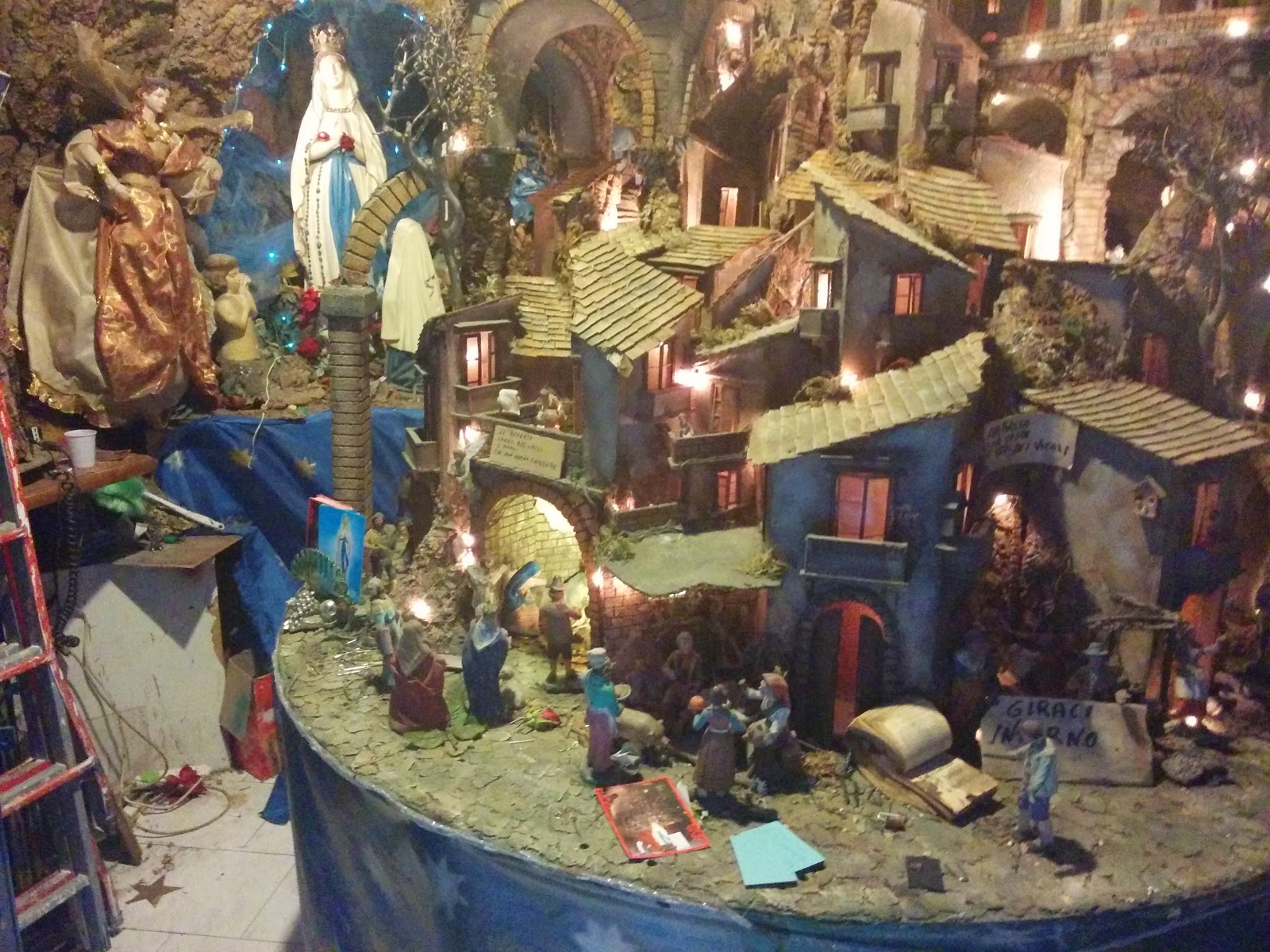
The original Greek city walls (says Julianne), "precepe" Christmas scenes which Naples is famous for, narrow streets with a mix of gothic and romanesque architecture. Strong reminders that Naples was under the French influence for centuries until Italian unification.  Naples looks different from other Italian places we have traveled so far.

Precepe-a nativity scene in Naples old town.
Jesus, Mary and Joseph are under the arch on the left.

I found myself making odd juxtapositions in images. How about Dante and girl graffiti? It was the hands that struck me.

Dante gestures

Girl caution

Oh, the day was wet, dark, not totally delightful. But though the sun didn't show, images did, small helps to my mood.


And some finely decorative bits. Chiesa Santa Chiara is supposed to be a great, nay, grand church, and significant in the history of Naples. Very old, it had been remodeled in the baroque style in the 17th century and was full of curly decorative stucco and happy statues of baby angels. But in WWII, as the Allies forced their way into Naples against the Nazis, this church was bombed to a shell. Maybe not even a shell, maybe just a pile of rubble. 

When it was rebuilt, the intent was to go back to the Gothic original. Frankly, it's a barn. Huge, grey, desperately plain - probably there was no money. The windows are simple and good, the rest you can't stand. 

But then, out back, behind the church and basically untouched by the bombing, this cloister garden of majolica tile. Our guidebook dismisses this garden, but I think in summer it would be very calm and restful. In this weather that we had, it felt pretty chilly in spite of the lemon trees bearing yellow fruit. 


I found a wonderful and unexpected delight in the dreary weather - Chiesa Santa Anna di Lombardi is off the beaten path, has a policy against photography (good luck with that), and basically seems torn between wanting to keep its privacy and wanting people to realize its great treasure, a painted ceiling by Giorgio Vasari.


I felt I could snatch only a single photo of this very pleasing ceiling.
Vasari did the large paintings, others the spritely miniatures.

Vasari wrote "Lives of the Most Excellent Painters, Sculptors and Architects," the first art historical writing about the visual arts. I quote Wikipedia: 

"Often called 'the first art historian', Vasari invented the genre of the encyclopedia of artistic biographies .... He was the first to use the term 'Renaissance' (rinascita) in print, though an awareness of the ongoing 'rebirth' in the arts had been in the air since the time of Alberti, and he was responsible for our use of the term Gothic Art, though he only used the word Goth which he associated with the 'barbaric' German style. The Lives also included a novel treatise on the technical methods employed in the arts."

This book is his great contribution, though it has many flaws, such as favoring his fellow Florentines, ignoring especially Venetian artists such as Titian, and quoting improbable gossip and stories. It's the reason we remember him. 

As you can see from my photo, he wasn't a bad painter. I like the light in his images, and his color palette. This was a bright spot for me in the drab day.


Sunday, it still rained. We went to the Archaeological Museum, which was fine enough - part was closed for lack of staff, naturally the part we wanted to see the most, but oh well. We looked at art in the subways, and went up to the top of Vomero hill for lunch at a pizzeria that wasn't really - it was a white-tablecloth restaurant with wonderful seafood. 

I (Julianne) was the only one of us three who managed to see much of the frescoes from Pompeii before that gallery closed. Strong color contrast of red-orange and blue-green in the frescoes. They used copper for the blue and showed a little pot of copper and painting tools which were found in Pompeii during excavations.


Boats on the Pompeii waterfront-fresco detail

Satyr with one-eyed creature,
fresco detail from Pompeii

The mosaics are superb--birds among other things. Much to see and absorb.     Although open on Sunday, budget woes do not allow enough staff to keep most galleries open.


Detail of mosaic showing sacred ibis and Egyptian geese


Pompeii mosaic with cat and birds

Fishes and ducks

Octopus, eel, squid, and various fishes

Mmmm - can we think about seafood?

Vomero is our neighborhood--steeper than San Francisco.  Renaissance defensive castles on lower levels, palaces next up, Arte Moderne reminiscent to us of Barcelona at the next upper turn of the road, up to the top with early 20 C.  All architectural styles I love.  

To get home from the Museum, we rode Metro Linea 1, an engineering feat of the late 20 C.  I am impressed that a subway can climb such a steep hill, which it does by circling around inside the mountain.  Wow.  I wonder if there is anywhere else in the world that has built a subway under such conditions? The stations are beautifully designed and decorated--we wanted to hop on and off at each one but we were hungry.  Art? Food? We got both at the Vanvitelli stop on the top.  Bus 128 down the hill to home--sunny now with gorgeous views.

Entrance to our metro station with elegant lights.

'Folk decoration' of the subway cars
photo by Donna Hecht Ellefson

Image result for art stations in the Naples subway
Image in Museo station

Image in Vanvitelli station

Sunday, home again, and the highlight of the week - you thought it was Vesuvius perhaps? - dinner with our landlady and her family. 

Gabriella Rinaldi and Max Carola. They are musicians, an old Neapolitan family, living just upstairs from us in a beautiful big flat, wonderful people. Their other guest a Dutch oboist moving to Umbria to start a b&b/arts colony. Onno Verschoor, very civil guy. We ate and ate, talked and talked far into the night.

A pleasure to meet the extended family, eat Neapolitan winter food, be among kindly generous people who take music seriously.  We have now been introduced to the music of Pino Daniele, who mixes Neapolitan music with R&B.  He died recently at too young of an age.  To see a video of him playing with Eric Clapton, click on this link: Pino Daniele with Eric Clapton

Our hosts, Max Carola and Gabriella Rinaldi, produced a concert by Richard Galliano at the Vesuvius Crater last summer, which you can hear by clicking this link: Richard Galliano at Vesuvius

Jazz accordion--seems like a contradiction, but it sure does work.

Max primarily does production and post-production, mainly these days in Berlin (the European center for contemporary music; he says it's the big youth scene these days). Here is a link to a youtube video he and Gabriella did together: Max and Gabriella.

Gabriella has a web presence, such as her business Voce e Canto (here's the link: voceecanto.it) and her own music in many youtube videos.

Monday morning, Donna and I went for a long walk, and then Julianne and I came back to Rome. It was a perfectly nice train, easy trip, hamburgers for supper, and realized the next morning the coffee is out, there's no bread, yogurt went bad, and so forth. Oh well, the week was worth the re-entry.

As we are back in our much-loved Roman apartment, I find that Naples has latched on to my heart.  It is hard to capture the essence, it was only one week. But I find myself unwilling to delete the Giranapoli bus app from my phone.


by Julianne and Nancy

PAESTUM, an Early Greek City in Italy, Thursday, February 19

More wine! More song! Painting from Paestum
Thursday, we went south to Paestum, the remains of an early Greek city - the Greeks were the first urban-dwellers in Italy, hiving off colonies as their cities grew too big to stay home. Eventually they were occupied and replaced by the Lucanians, who were overrun by the Romans, who left their mark in the expansive Forum and an amphitheater, among other buildings now reduced to foundations - the surviving temple buildings are Greek.

Paestum (says Julianne) was the first Greek city on the Italian peninsula and has three stunning Greek temples still standing much intact.  The settlers were from Euboea.  A Roman stadium, the Roman road and the floors and foundations of living areas remain in the mix at the site. Great museum too, with enough of the prehistory to identify human occupation back to the earliest days--Achulean hand axes up to copper blades before the Greeks arrived with their grape vines and incredible pottery.

My desire (says Nancy) was to sit in the sun and paint. I didn't do as much walking around and studying the remains as Julianne and Donna did, but tramped directly to the large temple of Neptune, and puzzled how to indicate its immense size when my paper is only 6x12 inches. Isn't that often the problem with painting? The world is so big, my imagery is so small. 

Finally I sat on some stone remains in front of the temple and painted what I saw gazing neither up nor down, but horizontally to the horizon. Here it is, imperfect but addressing the question:


Paestum, two temples. Hera on the left, Neptune on the right.

Donna came by and told me I was sitting on the sacrificial altar, where the priests killed animals for all to see. So then I looked around, and took pictures of the whole temple.


Temple of Neptune from a distance, Hera beyond

Julianne's picture of me painting.
I'm the speck in the lower right.
That temple is big.

Notice the temple elements in the picture above. Up under the eaves are flat areas separated by vertical elements in threes. Those verticals are called triglyphs while the carved pictures that were between them are metopes. The metopes are missing of course, but a few from the temple of Hera were preserved and found their way into the museum. Wikipedia says: "The oldest [ever found] are the metopes of Heraion at the mouth of the Sele at Poseidonia, preserved at the National Archaeological Museum of Paestum." Archaic language. Heraion = temple of Hera. Poseidonia is the earlier Greek name for Paestum, which is the Roman name. Sele is the local river. The metopes are from 500 BCE, 2500 years ago.

Metope from the Temple of Hera


Prancing lion from a tomb painting


Life-size marble head found in Temple of Neptune.
Museum speculates the body was plaster,
and disintegrated over time.

Aphrodite dancing on a jar. Winged figures
and fanciful plant forms.

Having looked through the museum, I have to say we liked the art of Paestum. Lots of paintings on the stone faces of the tombs and the caskets inside the tombs, lots of pottery. The citizens of Paestum lived their lives in decorative surroundings.

Having been driven around, upon return to Naples we had enough energy to walk around central Naples and watch the sunset with beverages in hand.  You can still get wine made from the Greek grape variety--Turco di Graeca-which is grown on the upper slopes east of Paestum.  Wine report--delicious.


Castel dell'Ovo from the bar of the Intercontinental

Pizza at 50 Kalo for dinner.  Yes--Naples is justly famous for pizza.  Yes--thick crust.  This restaurant is part of the Italian movement to celebrate local products and slow food excellence.  In a city of excellent pizza, when we left people were lined up outside the door.  Luckily, we have the American habit of eating early and got in as the place opened, at 7:30. 

See pictures of our pizza at 50 Kalo in Julianne's post about pizza in Naples.

Then home by taxi and fall into bed looking for tomorrow and Campi Fleigre.

By Nancy and Julianne